
Steam at 120°C is continuously passed through a 50 cm long rubber tube of inner and outer radii 1.0 cm and 1.2 cm. The room temperature is 30°C. Calculate the rate of heat flow through the walls of the tube. Thermal conductivity of rubber = 0.15 J s–1 m–1 °C–1.
Given:
Steam temperature: T1 = 120 °C
Length of the tube : l = 50 cm = 0.5 m
Inner radii of the tube: r = 1 cm = 0.01 m
Outer radii of the tube : R = 1.2 cm = 0.012 m
Room temperature: T2 = 30 °C
Thermal conductivity of rubber: K = 0.15 J s–1 m–1 °C–1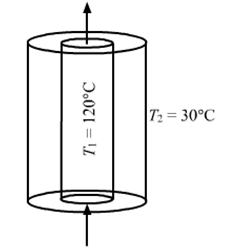
Formula used:
Rate of amount of heat flowing or heat current is given as: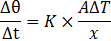
Here, Δθ is the amount of heat transferred, ΔT is the temperature difference, K is the thermal conductivity of the material, A is the area of cross section of the material and x is the thickness or length of the material.
Consider an element dx at a distance of x from the center between r and R.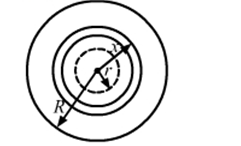
We will integrate this element dx to find total heat transferred from the tube.
Heat flow can be given as q = Δθ /Δt
In differential form: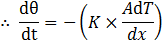
Here we used negative sign because the heat flow decreases with increase in thickness dx
Also, Area of the tube formed due to element dx can be given as
A = 2πxl
Here, x is the radius of the tube due to dx and l is the length of the tube.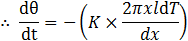

Now we integrate both the sides, taking temperature from tube to surrounding: T1 to T2 and radii from r to R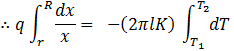


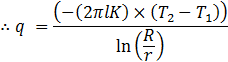
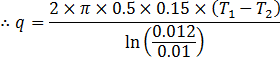

Hence, the rate of heat flow through the walls of the tube is 232.50 J/s.
Couldn't generate an explanation.
Generated by AI. May contain inaccuracies — always verify with your textbook.