
Two bodies of masses m1 and m2 and specific heat capacities s1 and s2 are connected by a rod of length ℓ, cross-sectional area A, thermal conductivity K and negligible heat capacity. The whole system is thermally insulated. At time t = 0, the temperature of the firs body is T1 and the temperature of the second body is T2(T2> T1). Find the temperature difference between the two bodies at time t.
Given-
Masses of body = m1 and m2
Specific heat capacities = s1 and s2
Rod of length= ℓ,
Cross-sectional area = A
Thermal conductivity = K
Rate of transfer of heat from the rod is given by –
 =
= (1)
(1)
Where, = temperature of first and second body.
A= Area of cross section of the
K = thermal conductivity of the
L= length
Heat transfer from the rod in time ∆t –
∆Q= (2)
(2)
Heat loss by the body at temperature T2 is equal to the heat gain by the body at temperature T1.
Heat loss by the body at temperature T2 in time ∆t is –
∆Q=m2s2  (T2′-T2) (3)
From (1) and (2)
m2s2  (T2′-T2) =
⇒ T2’=T2-  ∆t
∆t
This is the fall in the temperature of the body at temperature T2.
Similarly, rise in temperature of water at temperature T1 is –
T1’=T1+  t
t
Change in the temperature
(T2′-T1′)
= T2-  ∆t - T1-
  t
t
⇒ {(T2′-T1′)-(T2-T1)}=-  ∆t -
∆t -  t
t
⇒  = -
= -
Where  is the rate of change of temperature difference
⇒ ∆T=
∆T= 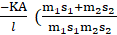 )
)
Integrating both the sides -
 =
=
⇒ ln |T2-T1| = -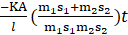
Taking the anti-log
⇒ (T2-T1)=e-λt
Where
λ=
Couldn't generate an explanation.
Generated by AI. May contain inaccuracies — always verify with your textbook.
