Q33 of 67 Page 98

Find the rate of heat flow through a cross-section of the rod shown in figure (θ2> θ1). Thermal conductivity of the material of the rod is K.


Let’s redraw the diagram
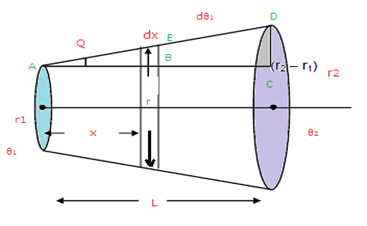


From the above diagram we can say that ΔABE is similar to ΔACD.


By the property of similar triangles-


=


x = r1 + (r2 – r1 )


Lets assume-


a =


r = ax + r1 (1)


Thermal resistance is given by –


dR =


Now area


dR =


dR =


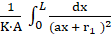
=


Solving above integral


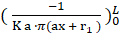
R =


R =


Rate of heat flow =


q = Kπr1r2


More from this chapter

All 67 →
31

Four identical rods AB, CD, CF and DE are joined as shown in figure. The length cross-sectional area and thermal conductivity of each rod are ℓ, A and K respectively. The ends A, E and F are maintained at temperatures T1, T2 and T3 respectively. Assuming no loss of heat to the atmosphere, final the temperature at B.


32

Seven rods A, B, C, D, E, F and G are joined as shown in figure. All the rods have equal cross-sectional area A and length ℓ. The thermal conductivities of the rods are KA = KC = KD, KD = 2KD, KE = 3KD, KF = 4KD and KD = 5KD. The rod E is kept at a constant temperature T1 and the rod G is kept at a constant temperature T2(T2> T1).

(a) Show that the rod F ahs a uniform temperature T = (T1 + 2T2)/3.


(b) Find the rate of heat flowing from the source which maintains the temperature T2.


34

A rod of negligible heat capacity has length 20 cm, area of cross-section 1.0 cm2 and thermal conductivity 200 W m–1 °C–1. The temperature of one end is maintained at 0°C and that of the other end is slowly and linearly varied from 0°C to 60°C in 10 minutes. Assuming no loss of heat through the sides, find the total heat transmitted through the rod in these 10 minutes.

35

A hollow metallic sphere of radius 20 cm surrounds a concentric metallic sphere of radius 5 cm. The space between the two spheres in filled with a nonmetallic material. The inner and outer spheres are maintained at 50°C and 10°C respectively and it is found that 100 J of heat passes from the inner sphere to the outer sphere per second. Find the thermal conductivity of the material between the spheres.