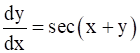
Solve the following differential equations:
(x + y)(dx–dy) = dx + dy
Given Differential equation is:
⇒ (x + y)(dx–dy) = dx + dy
⇒ (x + y)dx –(x + y)dy = dx + dy
⇒ (x + y–1)dx = (x + y + 1)dy
⇒  ……(1)
……(1)
Let us assume z = x + y
Differentiating w.r.t x on both sides we get,
⇒ 
⇒ 
⇒  ……(2)
……(2)
Substituting (2) in (1) we get,
⇒ 
⇒ 
⇒ 
⇒ 
Bringing like variables on same side(i.e., variable seperable technique) we get,
⇒ 
⇒ 
⇒ 
⇒ 
Integrating on both sides we get,
⇒ 
We know that:
(1) ∫ adx = ax + C
(2) 
⇒ 
Since z = x + y we substitute this,
⇒ x + y + log(x + y) = 2x + C
⇒ y + log(x + y) = x + C
∴ The solution for the given Differential equation is y + log(x + y) = x + C.
Couldn't generate an explanation.
Generated by AI. May contain inaccuracies — always verify with your textbook.