Solve the following differential equations :

Formula:-
(i) If a differential equation is  ,
,
then y(I.F) = ∫Q.(I.F)dx + c, where I.F = e∫Pdx
(ii) ∫dx = x + c


Given:-
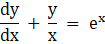
This is a linear differential equation, comparing it with

 , Q =
, Q = 
I.F = e∫Pdx

= elogx
= x
Solution of the equation is given by
y(I.F) = ∫Q.(I.F)dx + c
⇒ yx = ∫ex xdx + c
⇒ yx = x∫ex dx– ∫ ( ∫ex dx)dx) + c
using integration by part
yx = xex–∫ex dx + c
⇒ yx = xex–ex + c
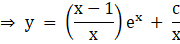
⇒ yx = (x–1)ex + c
AI is thinking…
Couldn't generate an explanation.
Generated by AI. May contain inaccuracies — always verify with your textbook.


