Solve each of the following initial value problems:
 , y(1) = 0
 , y(1) = 0
Given  and y(1) = 0



This is a first order linear differential equation of the form

Here,  and
and 
The integrating factor (I.F) of this differential equation is,

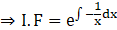
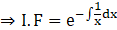
We have 

 [∵ m log a = log am]
∴ I.F = x–1 [∵ elog x = x]
Hence, the solution of the differential equation is,
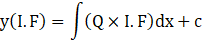

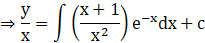
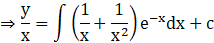
Let 

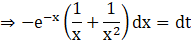
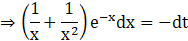
By substituting this in the above integral, we get

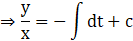
We know 

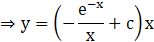
∴ y = –e–x + cx
However, when x = 1, we have y = 0
⇒ 0 = –e–1 + c(1)
⇒ 0 = –e–1 + c
∴ c = e–1
By substituting the value of c in the equation for y, we get
y = –e–x + (e–1)x
∴ y = xe–1 – e–x
Thus, the solution of the given initial value problem is y = xe–1 – e–x
Couldn't generate an explanation.
Generated by AI. May contain inaccuracies — always verify with your textbook.


