Solve the following equations:

Given Differential equation is :
⇒  ……(1)
……(1)
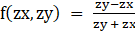
Homogeneous equation: A equation is said to be homogeneous if f(zx,zy) = znf(x,y) (where n is the order of the homogeneous equation).
Let us assume:
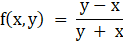
⇒ 
⇒ 
⇒ 
⇒ f(zx,zy) = z0f(x,y)
So, given differential equation is a homogeneous differential equation.
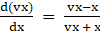
We need a substitution to solve this type of linear equation, and the substitution is y = vx.
Let us substitute this in (1)
⇒ 
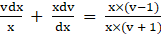
We know that:
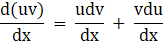
⇒ 
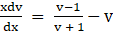
⇒ 
⇒ 
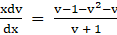
⇒ 
⇒ 
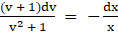
Bringing like variables on one side we get,
⇒ 
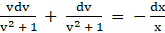
⇒ 
⇒ 
⇒ 
We know that:
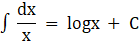
and Also,

Integrating on both sides, we get,
⇒ 
⇒ 
(∵ LogC is an arbitrary constant)
⇒ 
(∵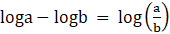 )
)
Since y = vx,
we get 
⇒ 
(∵ xloga = logax)
⇒ 
⇒ 
⇒ 
⇒ 
(Assuming log(c2) = K a constant)
∴ The solution to the given differential equation is log(y2 + x2) + 2tan-1 = K
= K
Couldn't generate an explanation.
Generated by AI. May contain inaccuracies — always verify with your textbook.


