In a simple circuit of resistance R, self inductance L and voltage E, the current i at any time t is given by  If E is constant and initially no current passes through the circuit, prove that
We know that in a circuit of R, L and E we have,
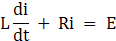
⇒ 
We can see that it is a linear differential equation of the form 
Where P =  and Q =
I.F = e∫Pdt
= e dt
dt
= 
Solution of the given equation is given by
i × I.F = ∫Q × I.F dt + c
⇒ i ×  = ∫
= ∫  ×
×  dt + c
⇒ i ×  = ∫
= ∫  ×
×  dt + c
⇒ i =  + c
+ c  ……(1)
……(1)
Initially, there was no current
So, at i = 0, t = 0


Now, putting the value of c in equation (1)
i =  –
– 
i =  (1 –
(1 –  )
)
AI is thinking…
Couldn't generate an explanation.
Generated by AI. May contain inaccuracies — always verify with your textbook.

