A ban pays interest by continuous compounding, that is, by treating the interest rate as the instantaneous rate of change of principal. Suppose in an account interest accrues at 8% per year, compounded continuously. Calculate the percentage increase in such an account over one year.
[Take e0.08≈1.0833]
Let the principal, rate and time be Rs P, r and t years.
Also, let the initial principal be Po.

⇒ 
Integrating both sides, we have
⇒ ∫ ∫dt
∫dt
⇒ log|P| =  t + c……(1)
Now, at t = 0, P = Po
log| Po | = 0 + c
⇒ c = log| Po |……(2)
Putting the value of c in equation (1) we have,
log|P| =  t + log|Po|
⇒ log|P| – log|Po| =  t
t
⇒ (log |P| – log|Po|) =  t [
t [ ]
]
⇒ log ( =
=  t ……(3)
Now, t = 1 year, r = 8%
∴ log ( =
=  ×1
×1
⇒ log ( = 0.08
⇒ 
⇒ 
⇒ 
(Given:  = 1.0833)
⇒ 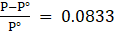
∴ Percentage increase = 0.0833×100 = 8.33%
Couldn't generate an explanation.
Generated by AI. May contain inaccuracies — always verify with your textbook.


