Q17 of 216 Page 456

A salt X is formed, and gas is evolved when ethanoic acid reacts with sodium hydrogen carbonate.

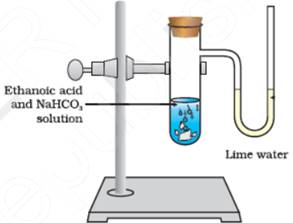
Name the salt X and the gas evolved. Describe an activity and draw the diagram of the apparatus to prove that the evolved gas is the one which you have named. Also, write chemical equation of the reaction involved.

Salt X is sodium ethanoate and the evolved gas is carbon dioxide.


The reaction is given below:


CH3COOH + NaHCO3 CH3COONa + H2CO3


Activity:


(a) Take a test tube and a bent tube.


(b) Take ethanoic acid and sodium bicarbonate solution in the test tube.


(c) Insert the bent tube in the cork and fit the cork at the mouth of the test tube.


(d) Fill lime water in the bent tube so that lime water is in the ‘U’ portion of this tube.


After some time; it is observed that the lime water turns milky. This confirms that the evolved gas is carbon dioxide. The diagram is given below:


More from this chapter

All 216 →
15

AB is a current-carrying conductor in the plane of the paper as shown in the figure. What are the directions of magnetic fields produced by it at points P and Q? Given r1 > r2, where will the strength of the magnetic field be larger?

16

(i) Distinguish between ionic and covalent compounds under the following properties:

(a) The strength of forces between constituent elements


(b) The solubility of compounds in water


(c) Electrical conduction in substances


(ii) Explain how the following metals are obtained from their compounds by the reduction process:


(a) Metal M which is in the middle of the reactivity series.


(b) Metal N which is high up in the reactivity series.


Given one example of each type.


OR


(i) Distinguish between ‘roasting’ and ‘calcination’. Which of these two is used for sulphide ores and why?


(ii) Write a chemical equation to illustrate the use of aluminium for joining cracked railway lines.


(iii) Name the anode, the cathode and the electrolyte used in the electrolytic refining of impure copper.

18

How are involuntary actions and reflex actions different from each other?

OR


(i) Why is the flow of signals in a synapse from the axonal end of one neuron to dendritic end of another neuron but not the reverse?


(ii) Sameer was studying in his room. Suddenly he smells something burning and sees smoke in the room. He rushes out of the room immediately. Was Sameer’s action voluntary or involuntary? Why?

19

(i) What is myopia? State the two causes of myopia. With the help of labelled ray diagrams show

(a) The eye defect myopia


(b) Correction of myopia using a lens.


(ii) Why is the normal eye unable to focus on an object placed within 10 cm from the eye?