The genotype of green-stemmed tomato plants is denoted as GG and that of purple-stemmed tomato plants as gg. When these two are crossed,
i. What colour of stem would you expect in their F1 progeny?
ii. Give the percentage of purple-stemmed plants if F1 plants are self-pollinated.
iii. In what ratio would you find the genotypes GG and Gg in the F2 progeny?
i. When green stemmed (GG) is crossed with purple stemmed (gg) tomato plant, the F1 progeny will have green stemmed tomato plants (Gg). The diagram below shows the cross in the form of punette square.
The genotype will be Gg in case of all the plants making the plant phenotypically green stemmed.
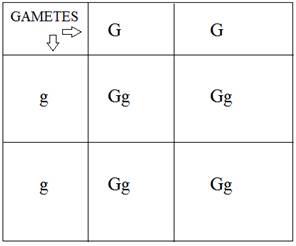
ii. When the F1 (Gg) plants will be self-pollinated the result will be:

When we study the self-pollination of F1 plants in the above figure we will observe that only one plant has both recessive alleles (gg).
Hence, the percentage of purple-stemmed plants when F1 is self-pollinated is 25%.
Explanation: the Purple stem is a recessive trait, and it will be able to express itself in homozygous conditions only. When progeny has gg then the plant will have purple stem
iii. The genotype GG represents stemmed green plant with both dominant alleles. The genotype Gg represents green stemmed plants with one allele being dominant (G) over the other allele (g, recessive)
Hence, on studying the above figure again, we observe that only 1 plant has GG genotype whereas the plants having Gg genotype are 2.
The ratio of GG and Gg in F2 progeny is 1:2.
Couldn't generate an explanation.
Generated by AI. May contain inaccuracies — always verify with your textbook.