Q17 of 216 Page 469

Why certain compounds are called hydrocarbons? Write the general formula for homologous series of alkenes, alkenes and also draw the structure of the first member of each series. Write the name of the reaction that converts alkenes into alkenes and also write a chemical equation to show the necessary conditions for the reaction to occur.

Certain compounds contain only carbon and hydrogen. so these organic compounds are called hydrocarbons.


Hydrocarbons are the simplest organic compounds. Containing only carbon and hydrogen, they can be straight-chain, branched chain, or cyclic molecules.


Carbon tends to form four bonds in a tetrahedral geometry. Hydrocarbon derivatives are formed when there is a substitution of a functional group at one or more of these positions.


There are three types of homologous families of hydrocarbons: alkanes, alkenes and alkynes. Alkanes contain only single bonds between carbon atoms. Alkenes contain at least one double bond. Alkynes contain at least one triple bond. Most of these types of hydrocarbons can exist with the same chemical formula in different form or chemical structure. When a compound has the same chemical formula but two possible structures, these two structures are called isomers.


Derivatives of Hydrocarbons-An almost unlimited number of carbon compounds can be formed by the addition of a functional group to a hydrocarbon.


In organic chemistry, a hydrocarbon is an organic compound consisting entirely of hydrogen and carbon, and thus are group 14 hydrides. Hydrocarbons from which one hydrogen atom has been removed are functional groups, called hydrocarbyls.
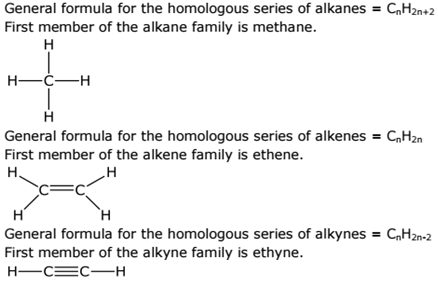

Capture2.PNG


Addition reaction or hydrogenation converts alkenes into alkanes.
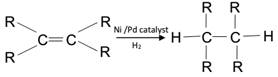


For example:


C2H4 (ethane) +H2 (hydrogen) C2H6 (ethane)


More from this chapter

All 216 →
15

State the rule to determine the direction of a

(i) magnetic field produced around a straight conductor-carrying current


(ii) force experienced by a current carrying straight conductor placed in a magnetic field which is perpendicular to it and


(iii) current induced in a coil due to its rotation in a magnetic field.


OR


What is the role of fuse used in series with any electrical appliance? Why should a fuse with defined rating not be replaced by one with a larger rating?

16

Write the names and symbols of two most reactive metals belonging to group I of the periodic table. Explain by drawing electronic structure how either one of the two metals reacts with a halogen. With which name is the bond formed between these elements known and what is the class of the compound so formed known? State any four physical properties of such compounds.

18

i. (a) which part of the nervous system controls reflex arcs?

(b) With the help of a diagram trace the sequence of events, which occur when we touch a hot object.


(c) Mention the part of the neuron that acquires information and the form in which information travels.


ii. Name the hormone synthesised at the shoot tips. How does it help the plant to response to light?


OR


i. What causes tendril to encircle or coil around the object in contact with it? Explain the process involved.


ii. What is chemotropism? Give one example.

19

i. A student suffering from myopia is not able to see distinctly the objects paced beyond 5m. List two possible reasons due to which this defect of vision may have arisen. With the help of ray diagrams, explain

(a) Why the student is unable to see distinctly the objects placed beyond 5 m from his eyes.


(b) The type of the corrective lens used to restore proper vision and how this defect is corrected by the use of this lens.


ii. If, in this case, the numerical value of the focal length of the corrective lens is 5 m, find the power of the lens as per the new Cartesian sign convention.