Q19 of 216 Page 469

i. A student suffering from myopia is not able to see distinctly the objects paced beyond 5m. List two possible reasons due to which this defect of vision may have arisen. With the help of ray diagrams, explain

(a) Why the student is unable to see distinctly the objects placed beyond 5 m from his eyes.


(b) The type of the corrective lens used to restore proper vision and how this defect is corrected by the use of this lens.


ii. If, in this case, the numerical value of the focal length of the corrective lens is 5 m, find the power of the lens as per the new Cartesian sign convention.

There are some possible reason due to this defect of vision may have arisen:


(a) Elongation of eyeball


(b) Excessive curvature of the lens.


(a) Student unable to see distinctly the objects placed beyond 5m from his eyes because student suffering with myopia. A myopic eye can't see distinct object clearly but able to see nearby object clearly.


(b) Convex lens of suitable focal length is used to restore proper vision. After using convex, image formed at retina. While before it, image was formed near the retina. As shown in figure it is clear how the lens correct this type of defect.


ii. Focal length of convex lens is positive


So, f = +5m


The dioptre is the unit of measure for the refractive power of a lens. The power of a lens is defined as the reciprocal


of its focal length in meters, or D = 1/f, where D is the power in dioptres and f is the focal length in meters.


Now, Power can be calculated as:
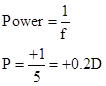


Hence, power is +0.2 dioptre


More from this chapter

All 216 →
17

Why certain compounds are called hydrocarbons? Write the general formula for homologous series of alkenes, alkenes and also draw the structure of the first member of each series. Write the name of the reaction that converts alkenes into alkenes and also write a chemical equation to show the necessary conditions for the reaction to occur.

18

i. (a) which part of the nervous system controls reflex arcs?

(b) With the help of a diagram trace the sequence of events, which occur when we touch a hot object.


(c) Mention the part of the neuron that acquires information and the form in which information travels.


ii. Name the hormone synthesised at the shoot tips. How does it help the plant to response to light?


OR


i. What causes tendril to encircle or coil around the object in contact with it? Explain the process involved.


ii. What is chemotropism? Give one example.

20

i. Draw the pattern of magnetic field lines through and around a current-carrying solenoid. What does the magnetic field pattern inside the solenoid indicate?

ii. How can this principle be utilised to make an electromagnet?


iii. State two ways by which strength of this electromagnet can be increased.


OR


Explain the underlying principle and working of an electric generator by drawing a labelled diagram. What is the function of brushes?

21

i. (a) Water is an elixir of life, a very important natural resource. Your Science teacher wants you to prepare a plan for a formative assessment activity, “How to save water, the vital natural resource”. Write any two ways that you will suggest to bring awareness in your neighbourhood, on ‘how to save water.’

(b) Name and explain any one way by which the underground water table does not go down further.


ii. Explain two main advantages associated with water harvesting at the community level.