
i. (a) which part of the nervous system controls reflex arcs?
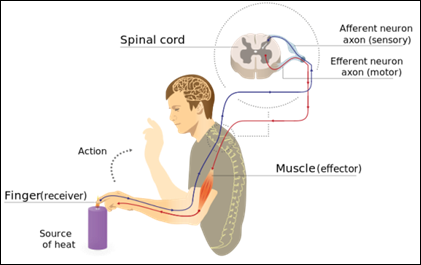
(b) With the help of a diagram trace the sequence of events, which occur when we touch a hot object.
(c) Mention the part of the neuron that acquires information and the form in which information travels.
ii. Name the hormone synthesised at the shoot tips. How does it help the plant to response to light?
OR
i. What causes tendril to encircle or coil around the object in contact with it? Explain the process involved.
ii. What is chemotropism? Give one example.
a. Reflex action or reflex is an involuntary action in response to a stimulus. This is a spontaneous action without thinking. For example, we adjust our eyes when exposed to bright light. Peripheral nervous system (PNS) is a system of nerves which connect central nervous system (CNS) (includes brain and spinal cord) with other parts of the body. Reflex action is the result of coordination of spinal cord and peripheral nervous system. This action does not involve the brain. The pathway in which impulses travel during the reflex action is called a reflex arc.
b. An action potential never travels to the brain for processing and so results in a much quicker reaction.
When a stimulus is encountered, the signal from that stimulus will travel up the sensory neuron to the spinal column. There, it will likely pass

through a short interneuron before continuing down a motor neuron to the origin of the signal. Then, a contraction of the muscles is triggered, moving the hand.
c. Dendrites of the neutron receive the information and it is nothing but it requires information that are part of the neuron family.
Likewise, the Axon of the neuron information travels as fast as electrical impulse taken by the dentritis action.
It has been emerged with neuron information and travels through the Axon.
Dendrite → cell body → axon to its ends.
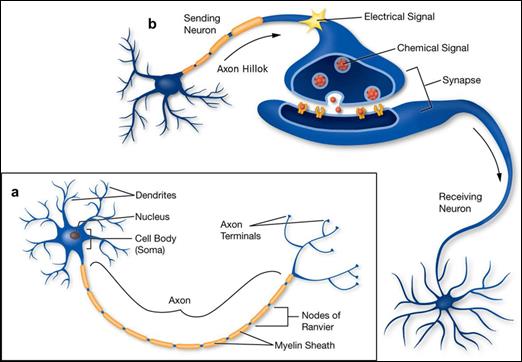
When neurons receive or send messages, they transmit electrical impulses along their axons, which can range in length from a tiny fraction of an inch to three feet or more. Many axons are covered with a layered myelin sheath, which accelerates the transmission of electrical signals along the axon.
ii. The plant hormone which is synthesised at the shoot tips is auxins. When growing plants detect light, hormone auxin, synthesised at the shoot tip, helps the cells to grow longer. When light is coming from one side of the plant, auxin diffuses towards the shady side of the shoot. This concentration of auxin stimulates the cells to grow longer on the side of the shoot which is away from light. Thus, the plant appears to bend towards light.
It can be explained by help of this diagram. This kind of movement is induced by light. The stem mostly grows and turns towards the source of light, therefore it is said to be positively phototropic. Auxin distribution controls phototropism.
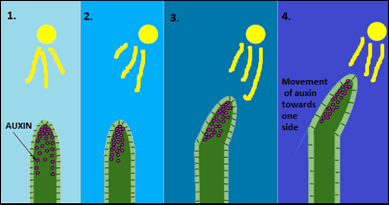
In 1, Sunlight strikes the plant from directly above. Auxin (pink dots) encourages growth straight up. In 2, 3, 4, Sunlight strikes the plant at an angle. Auxin is concentrated on one side, encouraging growth at an angle from the preceding stem. More growth of the stem on the shaded side is due to more accumulation of auxin on the shaded side than on the illuminated side.
This unequal distribution of auxins on the two sides may be due to following two reasons:
(i) Translocation of auxins from illuminated side to the shaded side.
(ii) Inhibition of auxin synthesis in the illuminated side (light side).
OR
They are many kinds of plants of which the climbers and creepers are considered movable plants. While creepers are plants that spread on the ground and climbers need a support structure for their growth. The support could either be a structure, a plant or a tree. Grapes, members of squash, melon family, cucumber and sweat pea are few examples of common tendril producing plants.
Certain vines use tendrils to climb towards the sun. Tendrils are specialized shoots, leaflets or leaves that are highly sensitive to touch. The effect of tendrils is to move the plant towards an object that it can cling to. So tendrils provide the plants a way of changing its position. As soon as it makes contact with a firm support, it secures its tight hold with a great speed. Growth on the side of origin of the tendril touching the support virtually stops but on the other side it may some 200 times as fast as normal.

When they form initially, they are almost straight. Then while growing it waves around. This process is called circumnutation. The direction of cirumnutation could be clockwise or counter clockwise depending on the species. The tip of the tendril is sensitive to auxin which is a growth stimulating chemical hormone. Auxin causes the tendrils to coil getting involved in the asymmetrical growth around the support
The part of the tendril in contact with the support doesn't grow as fast as the other part of plants; it coils around the support with the help of plant hormone called Auxin. This causes the tendril to coil around the support. The unequal growth is due to more secretion of auxin in the other end and less secretion in the end in contact with the support.
ii. The growth of a plant part due to chemical stimulus is known as chemotropism
'Chemotropism is growth of organisms such as bacteria and plants, navigated by chemical stimulus from outside of the organism or organism's part. The response of the organism or organism part is termed ‘positive’ if the growth is towards the stimulus or ‘negative if the growth is away from the stimulus.
An example of chemo-tropic movement can be seen during the growth of the pollen tube, where growth is always towards the ovules. It can be also written that conversion of flower into fruit is an example of chemotropism.
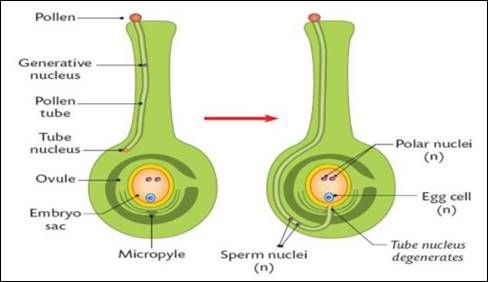
Fertilization of flowers by pollen is achieved because the ovary releases chemicals that produce a positive chemo-tropic response from the developing pollen tube.
An example of positive and negative chemotropism is shown by a plant’s roots; the roots grow towards useful minerals displaying positive chemotropism, and grow away from harmful acids displaying negative chemotropism.
Couldn't generate an explanation.
Generated by AI. May contain inaccuracies — always verify with your textbook.