
i. Explain an activity to show that a current-carrying conductor experiences a force when placed in a magnetic field.
ii. State the rule which gives the direction of force acting on the conductor.
i. Force on a current carrying conductor placed in a magnetic field
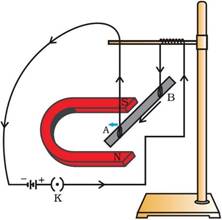
French scientist Andre Marie Ampere (1775–1836) suggested that when a current-carrying conductor is placed in a magnetic field it will experience a force. The force due to a magnetic field acting on a current-carrying conductor can be demonstrated through the following activity.
1.Take a small metal (preferable aluminium) rod AB of about 5-10 cm in length. Using two connecting wires suspend it horizontally from a stand, as shown in the diagram.
2.Place a strong horse-shoe magnet in such a way that the rod lies between the two poles with the magnetic field directed upwards. For this put the north pole of the magnet vertically below and south pole vertically above the rod.
3. Connect the rod in series with a battery, a key, and a rheostat.
4. Press the key ‘k’ to let the current flow through the rod.
Observations - It is observed that the rod is displaced towards the left. Reversing the direction of current flowing (by changing the polarity of the battery) through the rod, it is observed that the direction of its displacement of the rod is now towards the right. The displacement of the rod in the above activity suggests that a force is exerted on the current-carrying rod when it is placed in a magnetic field. It also suggests that the direction of force is also reversed when the direction of current through the conductor is reversed.
ii. Fleming’s Left-Hand Rule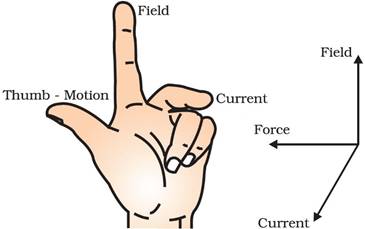
Fleming’s left-hand rule states that when you stretch the thumb, forefinger and middle finger of your left hand such that they are mutually perpendicular and if the first finger points in the direction of magnetic field and the second finger in the direction of current, then the thumb will point in the direction of motion or the force acting on the conductor.
Couldn't generate an explanation.
Generated by AI. May contain inaccuracies — always verify with your textbook.