Q19 of 216 Page 496

i. What is pollination? Give its two types.

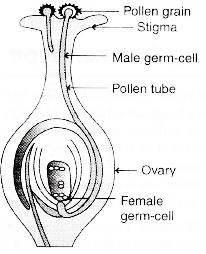
ii. Draw a longitudinal section of female reproductive part of a flower showing germination of the pollen grain. The label on it the following:


(a) Stigma;


(b) Pollen tube with a male germ cell;


(c) Female germ cell.

(i) POLLINATION: Pollination is the act of transferring pollen grains from the male anther of a flower to the female stigma.


TYPES OF POLLINATION


Pollination is chiefly of two types:


• self-pollination


• cross-pollination


SELF POLLINATION: It is the transfer of pollen grains from the anther to the stigma of either the same flower or another flower of the same plant.


It is of two types-


Autogamy- when pollens are transferred from the anther to the stigma of the same flower.


Geitonogamy- when pollens are transferred from the anther to the stigma of another flower of the same plant.


CROSS-POLLINATION: It is the transfer of pollen grains from the anther to the stigma of a flower on the different plant.


It is sometimes also referred to as Xenogamy or Allogamy.


(ii) A diagram showing a longitudinal section of female reproductive part of a flower showing germination of the pollen grain is as follows:


More from this chapter

All 216 →
17

i. What were the two major shortcomings of Mendeleev’s periodic table? How have these been removed in the modern periodic table?

ii. Two elements X and Y have atomic numbers 12 and 16 respectively. Write the electronic configuration for these elements. To which period of the modern periodic table do these two elements belong? What type of bond will be formed between them and why?

18

i. Draw the diagram of a heart and label its four chambers.

ii. Construct a table to show the functions of these four chambers.


OR


Plants absorb water from the soil. How does this water reach the tree tops? Explain in detail.

20

Draw ray diagrams to show the formation of a three times magnifier (i) real image (ii) virtual image of an object kept in front of a converging lens. Mark the positions of object, F, 2F, O and position of image clearly in the diagram.

An object of size 5 cm is kept at a distance of 25 cm from the optional centre of a converging lens of focal length 10cm. Calculate the distance of the image from the lens and size of the image.

21

A current of 1 ampere flows in a series circuit having an electric lamp and a conductor of 5 ohm when connected to a 10 V battery. Calculate the resistance of the electric lamp.

Now if a resistance of 10 ohm is connected in parallel with this series combination, what change (if any) in current flowing through 5 ohm conductor and potential difference across the lamp will take place? Give reason.


OR


B1, B2, B3 are three identical bulbs connected as shown in the figure. Ammeters A1, A2, A3 are connected as shown. When all the bulbs glow, the current of 3A is recorded by ammeter A.


i. What happens to the glow of the other two bulbs when bulb B1 gets fused?


ii. What happens to the reading of A1, A2, A3 and A when the bulb B2 gets fused?


iii. How much power is dissipated in the circuit when all the three bulbs glow together?