
Three consecutive vertices of a parallelogram are (-2, -1), (1, 0) and (4, 3). Find the fourth vertex
Let three vertices be A(-2, -1), B(1, 0) and C(4, 3) and fourth vertex be D(x, y)
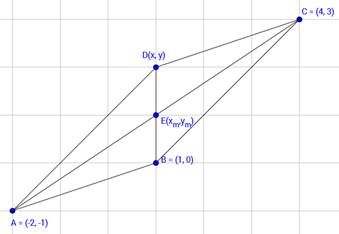
It is given that quadrilateral joining these four vertices is parallelogram.
∴□ABCD is parallelogram
We know that diagonals of parallelogram bisect each other, ie midpoint of the diagonals coincide.
Let E(xm , ym) be the midpoint of diagonals AC and BD.
By midpoint formula,
x =  , y =
, y = 
For diagonal AC,
xm =  , ym =
∴ xm =  , ym =
∴ E(xm , ym) ≡ (1, 1)
For diagonal BD,
1 =  , 1 =
, 1 = 
∴ x = 2 – 1 , y = 2 – 0
∴ x = 1 and y = 2
Hence, our fourth vertex is D(1, 2)
Couldn't generate an explanation.
Generated by AI. May contain inaccuracies — always verify with your textbook.