
ABCD is a rectangle formed by joining the points A (-1, -1), B (-1, 4), C (5, 4) and D (5,-1). P, Q, R and S are the mid-points of sides AB, BC, CD and DA respectively. Is the quadrilateral PQRS a square? a rectangle? or a rhombus? Justify your answer.
Here given that A (-1, -1), B (-1, 4), C (5, 4) and D (5,-1).Also P, Q, R and S are the mid-points of sides AB, BC, CD and DA respectively.
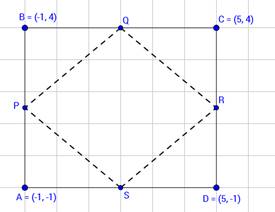
By midpoint formula.
x =  , y =
, y = 
For midpoint P of side AB,
x =  , y =
, y = 
x = -1 , y = 
Hence, the coordinates of P are (-1 ,  )
)
For midpoint Q of side BC,
x =  , y =
, y = 
x = 2 , y = 4
Hence, the coordinates of Q are (2 ,4)
For midpoint R of side CD,
x =  , y =
, y = 
x = 5 , y = 
Hence, the coordinates of R are (5 ,  )
)
For midpoint S of side AD,
x =  , y =
, y = 
x = 2 , y = -1
Hence, the coordinates of S are (2 ,-1)
Now we find length of the length of the □PQRS,
By distance formula,
XY = 
For PQ,
PQ = 
= 
=  units
units
For QR,
QR = 
= 
=  units
units
For RS,
RS = 
= 
=  units
units
For PS,
PS = 
= 
=  units
units
Here we can observe that all lengths of □PQRS are equal.
Now for diagonal PR,
PR = 
= 
=  units
units
Now for diagonal QS,
QS = 
= 
= 5 units
Here in □PQRS, diagonals are unequal.
We know that a quadrilateral whose all sides are equal and diagonals are unequal, it is a rhombus.
Hence, our □PQRS is rhombus .
Couldn't generate an explanation.
Generated by AI. May contain inaccuracies — always verify with your textbook.
