Q11 of 104 Page 306

A conducting loop of face-area A and resistance R is placed perpendicular to a magnetic field B. The loop is withdrawn completely from the field. Find the charge which flows through any cross-section of the wire in the process. Note that it is independent of the shape of the loop as well as the way it is withdrawn.


Given:


Face area of loop =A


Resistance of loop=R


Magnetic field intensity =B


Magnetic flux(ϕ) through the loop is given by the formula


Where B=magnetic field intensity


A=area of cross section


θ =angle between area vector and magnetic field


initially loop is perpendicular to the applied magnetic field hence initial flux is


Finally, when the loop is withdrawn from the field flux is given by


Now,


Average induced emf in time interval Δt is given by


…(i)


Where


are flux across the cross section at time intervals respectively


Using eqn.(i) we get


Current flowing in the loop is calculated by using formula


Hence the charge (Q) flowing through the loop is
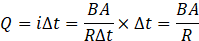


Therefore, charge flowing through any cross-section of the wire is BA/R


More from this chapter

All 104 →
9

Figure shows a conducting square loop placed parallel to the pole-faces of a ring magnet. The pole-faces have an area of 1 cm2 each and the field between the poles is 0.10 T. The wires making the loop are all outside the magnetic field. If the magnet is removed in 1.0 s, what is the average emf induced in the loop?


10

A conducting square loop having edges of length 2.0 cm is rotated through 180° about a diagonal in 0.20 s. A magnetic field B exists in the region which is perpendicular to the loop in its initial position. If the average induced emf during the rotation is 20 mV, find the magnitude of the magnetic field

12

A long solenoid of radius 2 cm has 100 turns/cm and carries a current of 5 A. A coil of radius 1 cm having 100 turns and a total resistance of 20 Ω is placed inside the solenoid coaxially. The coil is connected to a galvanometer. If the current in the solenoid is reversed in direction, find the charge flown through the galvanometer.

13

Figure shown a metallic square frame of edge an in a vertical plane. A uniform magnetic field B exists in the space in a direction perpendicular to the plane of the figure. Two boys pull the opposite corners of the square to deform it into a rhombus. They start pulling the corners at t = 0 and displace the corners at a uniform speed u.

(a) Find the induced emf in the frame at the instant when the angles at these corners reduced to 60°.


(b) Find the induced current in the frame at this instant if the total resistance of the frame is R.


(c) Find the total charge which flows through a side of the frame by the time the square is deformed into a straight line.
