Q25 of 104 Page 306

Suppose the ends of the coil in the previous problem are connected to a resistance of 100 Ω. Neglecting the resistance of the coil, find the heat produced in the circuit in one minute.


Given:


Resistance of the coil R=100Ω


Time period T=1min =60s


From previous question induced emf is given by



Current in the coil i is given by


…. (i)


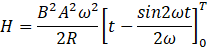
Heat produced in the circuit is calculated by the following formula



Using eqn.(i) we get,
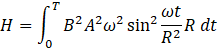


Putting the values of B, A, ω, T and R we have



Therefore heat produced in the circuit in one minute is


More from this chapter

All 104 →
23

A coil of radius 10 cm and resistance 40 Ω has 1000 turns. It is placed with its plane vertical and its axis parallel to the magnetic meridian. The coil is connected to a galvanometer and is rotated about the vertical diameter through an angle of 180°. Find the charge which flows through the galvanometer if the horizontal component of the earth’s magnetic field is BH = 3.0 × 10⁻⁵ T.

24

A circular coil of one turn of radius 5.0 cm is rotated about a diameter with a constant angular speed B = 0.010 T exists in a direction perpendicular to the axis or rotation. Find

(a) the maximum emf induced,


(b) the average emf induced in the coil over a long period and


(c) the average of the squares of emf induced over a long period.


26

Figure shows a circular wheel of radius 10.0 cm whose upper half, shown dark in the figure, is made of iron and the lower half of wood. The two junctions are joined by an iron rod. A uniform magnetic field B of magnitude 2.00 × 10⁻⁴ T exists in the space above the central line as suggested by the figure. The wheel is set into pure rolling on the horizontal surface. If it takes 2.00 seconds for the iron part to come down and the wooden part to go up, find the average emf induced during this period.


27

A 20 cm long conducting rod is st into pure translation with a uniform velocity of 10 cm s–1 perpendicular to its length. A uniform magnetic field of magnitude 0.10 T exists in a direction perpendicular to the plane of motion.

(a) Find the average magnetic force on the free electrons of the rod.


(b) For what electric field inside the rod, the electric force on a free electron will balance the magnetic force? How is this electric field created?


(c) Find the motional emf between the ends of the rod.