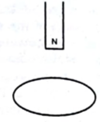
Figure shows a square loop of side 5 cm being moved towards right at a constant speed of 1 cm/s. The front edge enters the 20 cm wide magnetic field at t = 0. Find the emf induced in the loop at
(a) t = 2s, (b) t = 10 s
(c) t = 22 s, (d) t = 30s

Given:
Side length of square loop=5cm
Speed of square loop
Width of magnetic field 
Magnetic field intensity =0.6T
(a) t=2s
distance moved by the loop
area of the loop under magnetic field =
area of rectangle of length 0.05m and width 0.02m

Now,
Initial magnetic flux through the loop  (at t=0)
Final magnetic flux through the loop is given by


Average induced emf in time interval Δt is given by
 …(i)
…(i)
Where
 are flux across the cross section at time intervals
  respectively.
Putting the values of  in eqn.(i),

Therefore magnitude of induced emf at t=2s is 
(b) t=10s
distance moved by the square loop 
at this moment, square loop is completely inside the magnetic field and area of loop through which flux pass 
so the flux linkage does not changes with time 
and thus from eqn.(i)

Therefore, magnitude of induced emf in the coil at t=10s is zero
(c) t=22s
distance moved by the loop 
the loop is moving out of the field, the area of loop under the field is 
the magnetic flux acting on the loop is

(- sign as the flux has decreased)
The induced emf is

Therefore magnitude of induced emf at t=22s is 
(d) t=30s
distance moved by the square loop
at this time, square loop is completely outside the magnetic field and the area of loo through which flux passes =0
hence the flux linkage through the loop remains zero 
and thus from eqn.(i)

Couldn't generate an explanation.
Generated by AI. May contain inaccuracies — always verify with your textbook.