
Figure shows a long U-shaped wire of width ℓ placed in a perpendicular magnetic field B. A wire of length ℓ is slid on the U-shaped wire with a constant velocity v towards right. The resistance of all the wires is r per unit length. At t = 0, the sliding wire is close to the left edge of the U-shaped wire. Draw an equivalent circuit diagram, showing the induced emf as a battery. Calculate the current in the circuit.

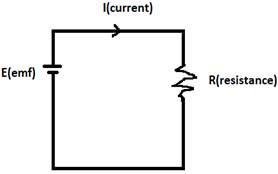
Current will flow from the left edge to the right, that is, in the clockwise direction. Therefore, the induced emf will also flow along the clockwise direction.
Diagram showing induced emf as a battery:
Given:
Resistance per unit length = r
Length of wire = l
Velocity with which the wire moves = v
Formula used:
We know, that  … (i), where E = emf, B = magnetic field, v = velocity with which the wire moves, l = length of wire.
Now, total resistance … (ii), where r = resistance per unit length, l’ = total length of loop
Horizontal length of loop = vt, where v = velocity, t = time.
Hence, total length of loop
Therefore, R(total resistance) =  … (iii), where r = resistance per unit length, l = length of wire
By Ohm’s law, we know that  where E = emf, I = current, R = total resistance. Hence, from (iii), we get,
  ……….(iv)
Equation (i) and (iv), we get:

=> 
Current in the circuit  (Answer)
Couldn't generate an explanation.
Generated by AI. May contain inaccuracies — always verify with your textbook.

