
A rectangular metallic loop of length ℓ and width b is placed
coplanarly with a long wire carrying a current i figure. The loop is moved perpendicular to the wire with a speed v in the plane containing the wire and the loop. Calculate the emf induced in the loop when the rear end of the loop is at a distance a from the wire. Solve by using Faraday’s law for the flux through the loop and also by replacing different segments with equivalent batteries.

Given: Length of the rectangular loop=l
Breadth of the rectangular loop=b
Current in the wire=i
Speed of loop=v
We have to find the emf induced in the loop by Faradays’s Law.
Faraday’s law states that whenever the magnetic flux through
a closed surface changes, there will be an induced emf prodced in
the loop that encloses the surface. The mathematical relation is
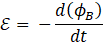
where  is the magnitude of the induced emf, ϕB is the the magnetic
flux through the surface. The negative sign arises because the
induced emf will be produced such that it will oppose the change of
magnetic flux. The magnetic flux is given by

where B is the magnetic field and dS is a small area element on the
surface.
The wire which is near the loop is responsible for the magnetic field .
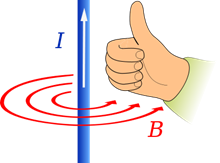
The wire is carrying current in the upward direction so by Fleming’s
right hand thumb rule, the magnetic field will be perpendicular to the
plane of the paper in the inward direction.
We have to now calculate the magnetic field acting across the loop.
Let us consider a small rectangular element of length b and width dx
at a distance of x from wire. The magnteic field on this element due
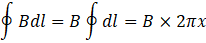
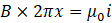
to the current carrying wire is given by Ampere circuital law.


(cos θ=1 because the  vector and
  vector are both acting in ward in the plane of paper so θ=0°, here dl is a small current carrying element of the circular amperian loop)

The magnetic flux through this element will be



(cosθ=1 because the magnetic field across the area and the normal
vector of this area element both point in the same direction so θ=0°
so cosθ=1)
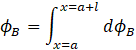
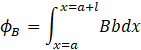
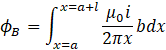
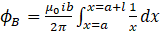
The total magnetic flux through the loop will be the flux through
Infinite such elementss from x=a to x=a+l
 (taking constants out of the integral)
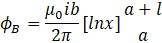

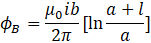
The flux through the loop is
The emf induced will be 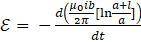
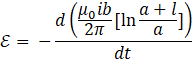
 (taking constants out of the differential)


(because  as the rate of change of Distance from wire is the loop speed)
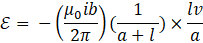
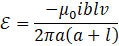
The magnitude of the induced emf is  .
.
Couldn't generate an explanation.
Generated by AI. May contain inaccuracies — always verify with your textbook.


