
Consider the situation of the previous problem.
(a) Calculate the force needed to keep the sliding wire moving with a constant velocity v.
(b) If the force needed just after t = 0 is F0, find the time at which the force needed will be F0/2.
Formula used:
(a) Magnetic force on a current carrying wire  where I = current, l = length of wire, B = magnetic field.
Since l and B are perpendicular to each other, magnetic force F becomes  … (i)
… (i)
Now, from the previous problem, … (ii)
Now, the force needed to keep the sliding wire from moving will be equal to the magnetic force, but in the opposite direction.
Let this force be F’.
Hence,  , where F = magnetic force, I = current, L = length of wire, B = magnetic field.
Substituting the value of I from (ii):
 =
= 
Hence, force required to keep the wire from sliding =  (Ans)
(Ans)
(b) Now, just after time t = 0, the force required to stop the wire from sliding will be  … (i) (substituting t = 0), from the previous part of this question.
Now, let the time taken for the required force to be  be t = T.
Hence, from the previous question, substituting t = T,
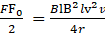 … (ii)
Substituting the value of F0 from (i), we get

⇒ 
⇒ 
Time taken for the force to reduce to  (Ans)
(Ans)
Couldn't generate an explanation.
Generated by AI. May contain inaccuracies — always verify with your textbook.


