Q49 of 104 Page 306

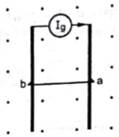
Figure shows a smooth pair of thick metallic rails connected across a battery of emf ϵ having a negligible internal resistance. A wire ab of length ℓ and resistance r can slide smoothly on the rails. The entire system lies in a horizontal plane and is immersed in a uniform vertical magnetic field B. At an instant t, the wire is given a small velocity v towards right.

(a) Find the current in it at this instant. What is the direction of the current?


(b) What is the force acting on the wire at this instant?


(c) Show that after some time the wire ab will slide with a constant velocity. Find this velocity.


Given:


Emf of the battery = ϵ


Length of sliding wire = l


Resistance = r


Magnetic field = B


Velocity = v


Formula used:


(a) Induced emf … (i), where B = magnetic field, l = length of sliding wire, v = velocity


Therefore, net emf =


Hence, current in the wire(Ans)


(b) Magnetic force acting on the wire … (ii), where i = current, l = length of sliding wire, B = magnetic field.


Hence, from (a),


Therefore, force (Ans)


(c) At constant velocity, net force will be 0.


Hence, = 0


Hence, value of velocity = (Ans)


More from this chapter

All 104 →
47

The system containing the rails and the wire of the previous problem is kept vertically in a uniform horizontal magnetic field B that is perpendicular to the plane of the rails figure. It is found that the wire stays in equilibrium. If the wire ab is replaced by


another wire of double its mass, how long will it take in falling through a distance equal to its length?


48

The rectangular wire-frame, shown in figure has a width d, mass m, resistance R and a large length. A uniform magnetic field B exists to the left of the frame. A constant force F starts pushing the frame into the magnetic field at t =0.

(a) Find the acceleration of the frame when its speed has increased to v.


(b) Show that after some time the frame will move with a constant velocity till the whole frame enters into the magnetic field. Find this velocity v0.


(c) Show that the velocity at time t is given by


50

A conducting wire ab of length ℓ, resistance r and mass m starts sliding at t = 0 down a smooth, vertical, thick pair of connected rails as shown in figure. A uniform magnetic field B exists in the space in a direction perpendicular to the plane of the rails.

(a) Write the induced emf in the loop at an instant t when the speed of the wire is v.


(b) What would be the magnitude and direction of the induced current in the wire?


(c) Find the downward acceleration of the wire at this instant.


(d) After sufficient time, the wire starts moving with a constant velocity. Find this velocity vm.


(e) Find the velocity of the wire as a function of time.


(f) Find the displacement of the wire as a function of time.


(g) Show that the rate of heat developed in the wire is equal to the rate at which the gravitational potential energy is decreased after steady state is reached.


51

A bicycle is resting on its stand in the east-west direction and the rear wheel is rotated at an angular speed of 100 revolutions per minute. If the length of each spoke is 30.0 cm and the horizontal component of the earth’s magnetic field is 2.0 × 10⁻⁵ T, find the emf induced between the axis and the outer end of a spoke. Neglect centripetal force acting on the free electrons of the spoke.