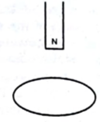
A long solenoid of radius 2 cm has 100 turns/cm and carries a current of 5 A. A coil of radius 1 cm having 100 turns and a total resistance of 20 Ω is placed inside the solenoid coaxially. The coil is connected to a galvanometer. If the current in the solenoid is reversed in direction, find the charge flown through the galvanometer.
Given:
Radius of solenoid 
No. of turns in the solenoid 
Current in the solenoid 
Radius of second coil 
No. of turns in the coil 
Resistance of the coil 
We know that,
Magnetic field inside solenoid (B) is given by formula

Where,
n=no. of turns per unit length
i=current through solenoid
Magnetic flux(ϕ) through the coil is given by the formula


Where B=magnetic field intensity
A=area of cross section of the coil
θ =angle between area vector and magnetic field
magnetic field inside solenoid is perpendicular to the coil
initially flux through the coil is given by

When the current in the solenoid is reversed in direction of magnetic field gets reversed and flux through the coil now m=becomes


Now,
Average induced emf in time interval Δt is given by
 …(i)
…(i)
Where
 are flux across the cross section at time intervals
  respectively
Putting these values in eqn.(i) we get
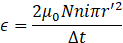
Current (i) through the coil of resistance R can be calculated as

Hence the charge (Q) passing through the coil in time Δt is
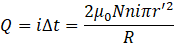
Putting the values of μ0, I, N, n π r’ and R in above eqn.

Therefore flowing through the galvanometer is 
Couldn't generate an explanation.
Generated by AI. May contain inaccuracies — always verify with your textbook.