
Figure shows a metallic wire of resistance 0.20 Ω sliding on a horizontal, U-shaped metallic rail. The separation between the parallel arms is 20 cm. An electric current of 2.0 μA passes through the wire when it is slid at a rate of 20 cm s–1. If the horizontal component of the earth’s magnetic field is 3.0 × 10⁻⁵ T, calculate the dip at the place.

Given:
Resistance of wire(R) = 0.2 Ω
Length of wire(l) = 20 cm = 0.2 m
Current(I) = 2 μA = 2 x 10⁻⁶ A
Velocity with which the wire moves(v) = 20 cms-1 = 0.2 ms-1
Horizontal component of earth’s magnetic field(BH) = 3.0 × 10⁻⁵ T
Formula used:
Angle of dip  ) … (i), where BV = vertical component of earth’s magnetic field, BH = horizontal component of earth’s magnetic field.
Now, emf induced in the wire  … (ii), where BV = vertical component of earth’s magnetic field, l = length of wire, v = velocity with which the wire moves
Also, by Ohm’s law … (iii), where E = emf, I = current, v = velocity.
Equating (ii) and (iii) we get
 = IR ⇒
Substituting the given values, we get
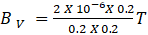 = 10-5 T
Hence, angle of dip ⇒  (Ans)
(Ans)
Couldn't generate an explanation.
Generated by AI. May contain inaccuracies — always verify with your textbook.


