
The magnetic field in the cylindrical region shown in figure increases at a constant rate of 20.0 mT/s. Each side of the square loop abcd and defa has a length of 1.00 cm and a resistance of 4.00 Ω. Find the current (magnitude and since) in the wire ad if
(a) the switch S1 is closed but S2 is open,
(b) S1 is open but S2 is closed,
(c) both S1 and S2 are open and
(d) both S1 and S2 are closed.

Given:
Rate of increase of magnetic field =
Side length of square loop =
Resistance of each side =4Ω
Area of the coil adef = area of coil abcd =
We know that,
Flux (ϕ) of magnetic field (B) through the loop of cross section area A in the magnetic field is given by


Since magnetic field is perpendicular to the loop the flux becomes

Rate of change of magnetic field wrt. time is given by
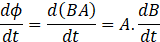
(since area of cross section in magnetic field does not change with time, A remains constant)
Now,
by faraday’s law of electromagnetic induction
 …(i)
…(i)
Where
ϵ =emf produced
ϕ =flux of magnetic field
using eqn.(i) the emf induced in the loop is given by
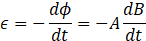
Hence the current through the loop (i) of resistance R is
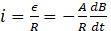 …(ii)
…(ii)
(a) when the switch S1 is closed but S2 is open
no current flows through loop abcd
net resistance of the loop adef R =4× 4 =16Ω
area of loop adef =
using eqn.(ii) current can be given by

As the magnetic field increases, the flux of magnetic field increases in downward direction so by Lenz’s law
The direction of induced current is such that it opposes the change that has induced it
Therefore, current flows in anticlockwise direction (along ad) to increase the magnetic flux in upward direction
(b) S1 is open but S2 is closed
No current flows in loop adef
Net resistance of loop abcd=4× 4=16Ω
Area of loop abcd =
using eqn.(ii) current can be given by

As the magnetic field increases, the flux of magnetic field increases in downward direction so by Lenz’s law
Therefore, current flows in anticlockwise direction (along da) to increase the magnetic flux in upward direction.
(c) When both S1 and S2 is open
No current flows in both the loop adef and abcd
And hence current in wire ad is zero

(d) When both S1 and S2 is closed
The circuit forms a balanced Wheatstone Bridge and the current flowing through the wire ad is zero

Concept of wheat stone bridge:
When the circuit forms a Wheatstone bridge in balanced condition then the current through galvanometer  becomes zero

Couldn't generate an explanation.
Generated by AI. May contain inaccuracies — always verify with your textbook.

