
The system containing the rails and the wire of the previous problem is kept vertically in a uniform horizontal magnetic field B that is perpendicular to the plane of the rails figure. It is found that the wire stays in equilibrium. If the wire ab is replaced by

another wire of double its mass, how long will it take in falling through a distance equal to its length?
Given:
Initial mass = m
Magnetic field = B
Length of sliding wire = l
Formula used:
Magnetic force  … (i), where i = current, l = length of sliding wire, B = magnetic field.
At equilibrium, this magnetic force balances the weight of the wire mg acting downward, where m = mass, g = acceleration due to gravity.
Therefore,  … (ii)
Now, when the wire ab is replaced by another wire of mass 2m, the weight acting downward will be 2mg, where g = acceleration due to gravity.
Hence, net force = 2mg - ilB … (iii) where 2m = mass, g = acceleration due to gravity, i = current, l = length of sliding wire, B = magnetic field.
According to Newton’s law of motion,  … (iv), where F = net force, m’ = mass, acceleration
In this case, m’ = 2m.
Therefore, equating (iii) and (iv), we get
2mg - ilB = 2ma
⇒  … (v)
… (v)
Now, distance travelled can be expressed as  … (vi), where s = distance travelled, u = initial velocity = 0(in this case), t = time, a = acceleration.
Now, distance travelled = l (given)
Therefore, from (v), (vi) becomes:
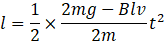
⇒ 
But, from (i),
Therefore,  ⇒
⇒ 
Required time taken =  (Ans)
(Ans)
Couldn't generate an explanation.
Generated by AI. May contain inaccuracies — always verify with your textbook.


