
A circle touches the side BC of ΔABC at P, AB and AC produced at Q and R respectively, prove that AQ = AR = ( perimeter of ΔABC)
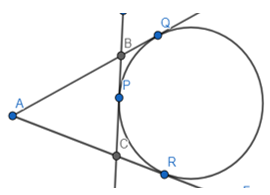
Lengths of tangents drawn from an exterior point to the circle are equal.
From the above theorem,
AR = AQ …(1)
BP = BQ …(2)
CP = CR …(3)
Now,
Perimeter of ΔABC = AB + BC + CA
⇒ Perimeter of ΔABC = AB + BP + PC + CA
⇒ Perimeter of ΔABC = (AB + BQ) + (CR + CA) [Using (2) and (3)]
⇒ Perimeter of ΔABC = AQ + AR
⇒ Perimeter of ΔABC = AQ + AQ
⇒ Perimeter of ΔABC = 2AQ [Using (1)]
 ∴ AQ = AR = 1/2Perimeter of ΔABC
Hence, Proved.
AI is thinking…
Couldn't generate an explanation.
Generated by AI. May contain inaccuracies — always verify with your textbook.
