Q4 of 67 Page 48

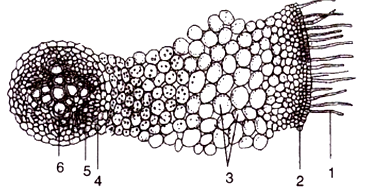
The diagram below represents a layer of epidermal cells showing a fully grown root hair.

Study the diagram and answer the questions that follow:


(b) The root hair cell is in a turgid state. Name and explain the process that caused this state.


(c) Mention one distinct difference between the parts labeled A and B.


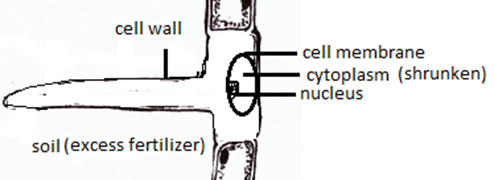
(d) Draw a diagram of the above root hair cell as it would appear when a concentrated solution of fertilizers is added near it.

(b) The root hair cell is turgid because of the endosmosis of water from its surrounding soil.

Endosmosis is the inward diffusion of water through a semi-permeable membrane when the surrounding solution is less concentrated. This leads to the swelling up of the cells and thus becomes turgid.


(c) The part labeled “A” is the cell wall.


The part labeled “B” is cell membrane.


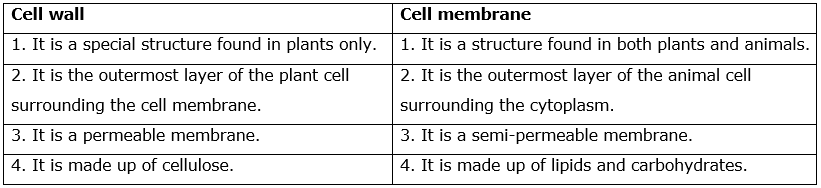
The differences between the cell wall and cell membrane are:


(d) When a concentrated solution of fertilizer is added near the root hair cell it undergoes exosmosis and thus gets plasmolysed.


More from this chapter

All 67 →
2

A leaf cell of a water plant was placed in a liquid other than pond water. After some time, it assumed a shape as shown below:


(a) Give the term for the state of the cell it has acquired.


(b) Comment on the nature (tonicity) of the liquid surrounding the cell.


(c) Redraw in the space provided, the diagram of the cell if it is soon placed in ordinary water for some time.

3

The diagram given below represents an experimental set-up to demonstrate a certain process. Study the same and answer the questions that follow:


(a) Name the process.


(b) Define the above-named process.


(c) What would you observe in the experimental set-up after an hour or so?


(d) What control experiment can be set up for comparison?


(e) Keeping –hair, cell and its surroundings, name the parts that correspond to (1) concentrated sugar solution (2) parchment paper and (3) water in the beaker.


(f) Name any other substance that can be used instead of parchment paper in the above experiment.


(g) Mention two advantages of the process to the plants.

5

Two potato cubes each 1 cm3 in size, were placed separately in two containers (A & B), the container (A) having water and the other (B) containing concentrated sugar solution. After 24 hours when the cubes were examined, those placed in water were found to be firm and had increased slightly in size and those placed in concentrated sugar solution were found to be soft and had somewhat decreased in size. Use the above information to answer the questions that follow:

(a) Account for the firmness and increase in the size of the potato cubes placed in water.


(b) Account for the softness and decrease in size of the potato cubes which were placed in sugar solution.


(c) Name and define the physical process being investigated in this experiment.

6

Given below is the diagrammatic representation of the transverse section of a part of a plant. Study it and answer the questions that follow:


(a) Name the part of the plant that is shown.


(b) Label the parts 1 to 6.


(c) Write the functions of parts 3 and 5.