Q1 of 118 Page 30

A small manufacturing firm produces two types of gadgets A and B, which are first processed in the foundry, then sent to the machine shop for finishing. The number of man - hours of labour required in each shop for the production of each unit of A and B, and the number of man - hours the firm has available per week are as follows:


The profit on the sale of A is Rs 30 per unit as compared with ₹ 20 per unit of B. The problem is to determine the weekly production of gadgets A and B, so that the total profit is maximized. Formulate this problem as a LPP.

The given data can be shown in a table as follows:
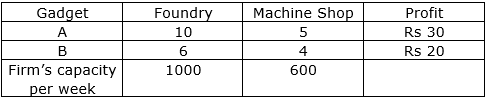


Now, let the required weekly production of gadgets A and B be x and y respectively


As it is given that profit on each gadget A is Rs. 30 and that on B is Rs. 20, so profit on x and y number of gadgets A and B respectively are 30x and 20y.


If z = total profit then we have,


z = 30x + 20y


Further, it is also given that the production of A and B requires 10 hours per week and 6 hours per week in the foundry. Also, the maximum capacity of the foundry is given as 1000 hours.


Now, x units of A and y units of B will require 10x + 6y hours


So, we have


10x + 6y ≤ 1000


This is our first constraint.


Given, production of one unit gadget A requires 5x hours per week and y units of gadget B requires 4y hours per week, but the maximum capacity of the machine shop is 600 hours per week.


So, 5x + 4y ≤ 600


This is our second constraint.


Hence, the mathematical formulation of LPP is:


Find x and y which will maximize z = 30x + 20y


Subject to constraints,


10x + 6y ≤ 1000


5x + 4y ≤ 600


and also, as production cannot be less than zero, so x, y ≥ 0


More from this chapter

All 118 →
2

A company is making two products A and B. The cost of producing one unit of products A and B are Rs 60 and Rs 80 respectively. As per the agreement, the company has to supply at least 200 units of product B to its regular customers. One unit of product A requires one machine hour whereas product B has machine hours available abundantly within the company. Total machine hours available for product A are 400 hours. One unit of each product A and B requires one labour hour each and total of 500 labour hours are available. The company wants to minimize the cost of production by satisfying the given requirements. Formulate the problem as a LPP.

3

A firm manufactures 3 products A, B and C. The profits are Rs. 3, Rs. 2 and Rs. 4 respectively. The firm has 2 machines and below is the required processing time in minutes for each machine on each product.


Machines M1 and M2 have 2000 machine minutes respectively. The firm must manufacture 100 A’s, 200 B’s and 50 C’s but not more than 150 A’s. Set up a LPP to maximize the profit.

4

A firm manufactures two types of products A and B and sells them at a profit of Rs 2 on type A and Rs 3 on type B. Each product is processed on two machines M1 and M2. Type A requires one minute of processing time on M1 and two minutes of M2; type B requires one minute on M1 and one minute on M2. The machine M1 is available for not more than 6 hours 40 minutes while machine M2 is available for 10 hours during any working day. Formulate the problem as a LPP.

5

A rubber company is engaged in producing three types of tyres A, B and C. Each type requires processing in two plants, Plant I and Plant II. The capacities of the two plants, in the number of tyres per day, are as follows:


The monthly demand for tyre A, B and C is 2500, 3000 and 7000 respectively. If plant I costs Rs 2500 per day, and plant II costs Rs 3500 per day to operate, how many days should each be run per month to minimize cost while meeting the demand? Formulate the problem as LPP.