Q10 of 118 Page 30

An automobile manufacturer makes automobiles and trucks in a factory that is divided into two shops. Shop A, which performs the basic assembly operation, must work 5 man - days on each truck but only 2 man - days on each automobile. Shop B which performs finishing operations, must work 3 man - days for each automobile or truck that it produces. Because of men and machine limitations, shop A has 180 man - days per week available while shop B has 135 man - days per week. If the manufacturer makes a profit of Rs 30000 on each truck and Rs 2000 on each automobile, how many of each should he produce to maximize his profit? Formulate this as a LPP.

Let number of automobiles produces be x and let the number of trucks


Produced be y.


Let Z be the profit function to be maximized.


Z = 2000x + 30000y


The constraints are on the man hours worked


Shop A 2x + 5y ≤ 180 (i) assembly


Shop B 3x + 3y ≤ 135 (ii) finishing


x, y ≥ 0


Corner points can ve obtained from


2x = 3y + 5y = 180 x = 0; y = 36 and x = 90; y = 0


3x + 3y ≤ 135 x = 0; y = 45 and x = 45; y = 0


Solving (i) and (ii) gives x = 15 and y = 30
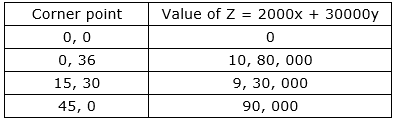


Thus 0 automobiles and 36 trucks give max. profit of Rs 10, 80, 000/ -


More from this chapter

All 118 →
8

A manufacturer can produce two products, A and B, during a given time period. Each of these products requires four different manufacturing operations: grinding, turning, assembling and testing. The manufacturing requirements in hours per unit of products A and B are given below.


The available capacities of these operations in hours for the given time period are: grinding 30; turning 60, assembling 200; testing 200. The contribution to profit is Rs 20 for each unit of A and Rs 30 for each unit of B. The firm can sell all that it produces at the prevailing market price. Determine the optimum amount of A and B to produce during the given time period. Formulate this as a LPP.

9

Vitamins A and B are found in two different foods F1 and F2. One unit of food F1 contains 2 units of vitamin A and 3 units of vitamin B. One unit of food F2 contains 4 units of vitamin A and 2 units of vitamin B. One unit of food F1 and F2 cost ₹ 50 and 25 respectively. The minimum daily requirements for a person of vitamin A and B is 40 and 50 units respectively. Assuming that anything in excess of daily minimum requirement of vitamin A and B is not harmful, find out the optimum mixture of food F1 and F2 at the minimum cost which meets the daily minimum requirement of vitamin A and B. Formulate this as a LPP.

11

Two tailors A and B earn Rs 150 and Rs 200 per day respectively. A can stitch 6 shirts and 4 pants per day while B can stitch 10 shirts and 4 pants per day. Form a linear programming problem to minimize the labour cost to produce at least 60 shirts and 32 pants.

12

An airline agrees to charter planes for a group. The group needs at least 160 first class seats and at least 300 tourist class seats. The airlines must use at least two of its model 314 planes which have 20 first class and 30 tourist class seats. The airline will also use some of its model 535 planes which have 20 first class seats and 60 tourist class seats. Each flight of a model 314 plane costs the company Rs 100, 000 and each flight of a model 535 plane costs Rs 150, 000. How many of each type of plane should be used to minimize the flight cost? Formulate this as a LPP.