Q7 of 118 Page 30

To maintain his health a person must fulfil certain minimum daily requirements for several kinds of nutrients. Assuming that there are only three kinds of nutrients – calcium, protein and calories and the person’s diet consists of only two food items, I and II, whose price and nutrient contents are shown in the table below:


What combination of two food items will satisfy the daily requirement and entail the least cost? Formulate this as a LPP.

Let x and y be the packets of 25 gm of Food I and Food II purchased. Let Z be the price paid. Obviously, price has to be minimized.


Take a mass balance on the nutrients from Food I and II,


Calcium 10x + 4y 20


5x + 2y 10 (i)


Protein 5x + 5 y 20


x + y 4 (ii)


Calories 2x + 6y > 13 (iii)


These become the constraints for the cost function, Z to be minimized i.e., 0.6x + y = 7, given cost of Food I is Rs 0.6/ - and Rs 1/ - per lb


From (i), (ii) & (iii) we get points on the X & Y - axis as [0, 5] & [2, 0] ; [0, 4] & [ 4, 0] ; [0, 13/6] & [6.5, 0] Plotting these
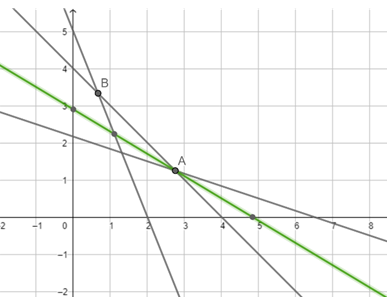


The smallest value of Z is 2.9 at the point (2.75, 1.25). We cannot say that the minimum value of z is 2.9 as the feasible region is unbounded.


Therefore, we have to draw the graph of the inequality 0.6x + y <2.9


Plotting this to see if the resulting line (in green) has any point common with the feasible region. Since there are no common points this is the minimum value of the function Z and the mix is


Food I = 2.75 lb; Food II = 1.25 lb; Price = Rs 2.9


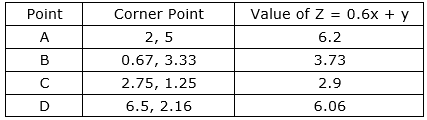
When Z has an optimal value (maximum or minimum), where the variables x and y are subject to constraints described by linear inequalities., this optimal value must occur at a corner point (vertex) of the feasible region.


Here the feasible region is the unbounded region A - B - C - D


Computing the value of 7 at the corner points of the feasible region ABHG


More from this chapter

All 118 →
5

A rubber company is engaged in producing three types of tyres A, B and C. Each type requires processing in two plants, Plant I and Plant II. The capacities of the two plants, in the number of tyres per day, are as follows:


The monthly demand for tyre A, B and C is 2500, 3000 and 7000 respectively. If plant I costs Rs 2500 per day, and plant II costs Rs 3500 per day to operate, how many days should each be run per month to minimize cost while meeting the demand? Formulate the problem as LPP.

6

A company sells two different products A and B. The two products are produced in a common production process and are sold in two different markets. The production process has a total capacity of 45000 man - hours. It takes 5 hours to produce a unit of A and B hours to produce a unit of B. The market has been surveyed and company officials feel that the maximum number of units of A that can be sold is 7000 and that of B is 10, 000. If the profit is Rs 60 per unit for the product A and Rs 40 per unit for the product B, how many units of each product should be sold to maximize profit? Formulate the problem as LPP.

8

A manufacturer can produce two products, A and B, during a given time period. Each of these products requires four different manufacturing operations: grinding, turning, assembling and testing. The manufacturing requirements in hours per unit of products A and B are given below.


The available capacities of these operations in hours for the given time period are: grinding 30; turning 60, assembling 200; testing 200. The contribution to profit is Rs 20 for each unit of A and Rs 30 for each unit of B. The firm can sell all that it produces at the prevailing market price. Determine the optimum amount of A and B to produce during the given time period. Formulate this as a LPP.

9

Vitamins A and B are found in two different foods F1 and F2. One unit of food F1 contains 2 units of vitamin A and 3 units of vitamin B. One unit of food F2 contains 4 units of vitamin A and 2 units of vitamin B. One unit of food F1 and F2 cost ₹ 50 and 25 respectively. The minimum daily requirements for a person of vitamin A and B is 40 and 50 units respectively. Assuming that anything in excess of daily minimum requirement of vitamin A and B is not harmful, find out the optimum mixture of food F1 and F2 at the minimum cost which meets the daily minimum requirement of vitamin A and B. Formulate this as a LPP.