
A furniture manufacturing company plans to make two products : chairs and tables. From its available resources which consists of 400 square feet of teak wood and 450 man hours. It is known that to make a chair requires 5 square feet of wood and 10 man - hours and yields a profit of ₹ 45, while each table uses 20 square feet of wood and 25 man - hours and yields a profit of ₹ 80. How many items of each product should be produced by the company so that the profit is maximum?
Let required production of chairs and tables be x and y respectively.
Since, profits of each chair and table is Rs. 45 and Rs. 80 respectively. So, profits on x number of type A and y number of type B are 45x and 80y respectively.
Let Z denotes total output daily, so,
Z = 45x + 80y
Since, each chair and table requires 5 sq. ft and 80 sq. ft of wood respectively. So, x number of chair and y number of table require 5x and 80y sq. ft of wood respectively. But,
But 400 sq. ft of wood is available. So,
5x + 80y  400
400
x + 4y  80 {First Constraint}
Since, each chair and table requires 10 and 25 men - hours respectively. So, x number of chair and y number of table require 10x and 25y men - hours respectively. But, only 450 hours are available . So,
10x + 25y  450
450
2x + 5y  90 {Second Constraint}
Hence mathematical formulation of the given LPP is,
Max Z = 45x + 80y
Subject to constraints,
x + 4y  80
80
2x + 5y  90
90
x,y  0 [Since production of chairs and tables can not be less than zero]
Region x + 4y  80: line x + 4y = 80 meets the axes at A(80,0), B(0,20) respectively.
Region containing the origin represents x + 4y  80 as origin satisfies x + 4y
  80
80
Region 2x + 5y  90: line 2x + 5y = 90 meets the axes at C(45,0), D(0,20) respectively.
Region containing the origin represents 2x + 5y  90
90
as origin satisfies 2x + 5y  90
90
Region x,y  0: it represents the first quadrant.
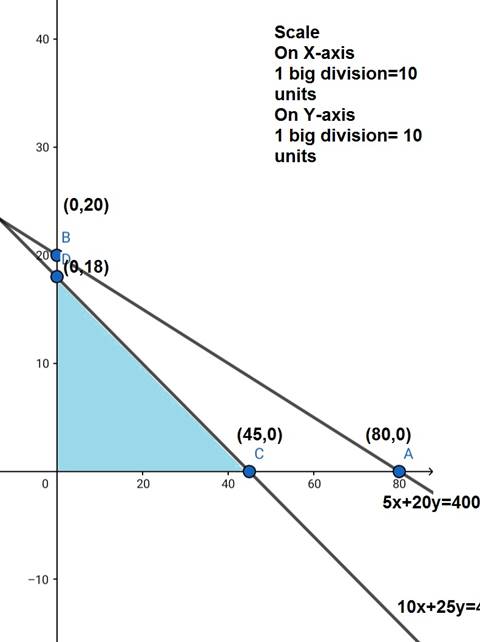
The corner points are O(0,0), D(0,18), C(45,0).
The values of Z at these corner points are as follows:

The maximum value of Z is 2025 which is attained at C(45,0).
Thus maximum profit of Rs 2025 is obtained when 45 units of chairs and no units of tables are produced.
Couldn't generate an explanation.
Generated by AI. May contain inaccuracies — always verify with your textbook.