
A gardener has a supply of fertilizer of type I which consists of 10% nitrogen and 6% phosphoric acid and type II fertilizer which consists of 5% nitrogen and 10% phosphoric acid. After testing the soil conditions, he finds that he needs at least 14 kg of nitrogen and 14 kg of phosphoric acid for his crop. If the type I fertilizer costs 60 paise per kg and type II fertilizer costs 40 paise per kg, determine how many kilograms of each fertilizer should be used, so that nutrient requirements are met at a minimum cost. What is the minimum cost?
Let x kg of Type I fertilizer and y kg of Type II fertilizers are supplied.
The quantity of fertilizers can not be negative.
So, x,y  0
0
A gardener has a supply of fertilizer of type I which consists of 10% nitrogen and Type II consists of 5% nitrogen, and he needs at least 14 kg of nitrogen for his crop.
So,
(10 100) + (5
 100)
100)  14
14
Or, 10x + 5y 1400
1400
A gardener has a supply of fertilizer of type I which consists of 6% phosphoric acid and Type II consists of 10% phosphoric acid, and he needs at least 14 kg of phosphoric acid for his crop.
So,
(6 100) + (10
 100)
100)  14
14
Or, 6x + 10y 1400
1400
Therefore, A/Q, constraints are,
10x + 5y 1400
1400
6x + 10y 1400
1400
If the Type I fertilizer costs 60 paise per kg and Type II fertilizer costs 40 paise per kg. Therefore, the cost of x kg of Type I fertilizer and y kg of Type II fertilizer is Rs0.60x and Rs 0.40y respectively.
Total cost = Z(let) = 0.6x + 0.4y is to be minimized.
Thus the mathematical formulation of the given LPP is,
Min Z = 0.6x + 0.4y
Subject to the constraints,
10x + 5y 1400
1400
6x + 10y 1400
1400
x,y  0
0
The region represented by 6x + 10y 1400: line 6x + 10y = 1400 passes through A(
 ,0) and B(0,140). The region which doesn’t contain the origin represents the solution of the inequation 6x + 10y
 1400
1400
As (0,0) doesn’t satisfy the inequation 6x + 10y 1400
1400
Region represented by 10x + 5y 1400: line 10x + 5y = 1400 passes through C(140,0) and D(0,280). The region which doesn’t contain the origin represents the solution of the inequation 10x + 5y
 1400
1400
As (0,0) doesn’t satisfy the inequation 10x + 5y 1400
1400
The region, x,y  0: represents the first quadrant.
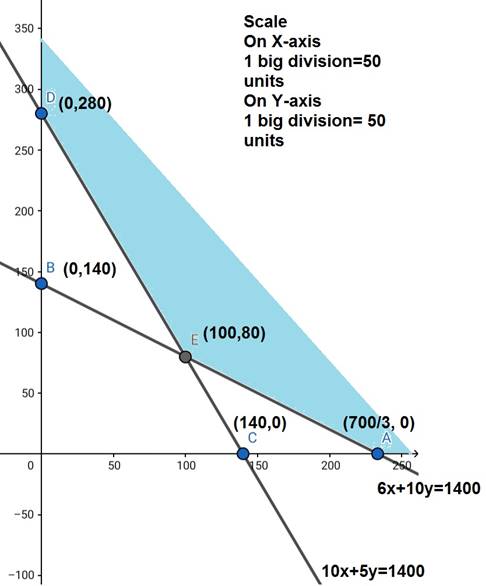
The corner points are D(0,280), E(100,80), A( ,0)
,0)
The values of Z at these points are as follows:
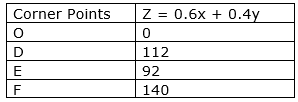
The minimum value of Z is Rs 92 which is attained at E(100,80)
Thus, the minimum cost is Rs92 obtained when 100 kg of Type I fertilizer and 80 kg of TypeII fertilizer is supplied.
Couldn't generate an explanation.
Generated by AI. May contain inaccuracies — always verify with your textbook.