Q15 of 118 Page 30

A fruit grower can use two types of fertilizer in his garden, brand P and Q. The amounts (in kg) of nitrogen, phosphoric acid, potash, and chlorine in a bag of each brand are given in the table. Tests indicate that the garden needs at least 240 kg of phosphoric acid, at least 270 kg of potash and at most 310 kg of chlorine.


If the grower wants to minimize the amount of nitrogen added to the garden, how many bags of each brand should be used? What is the minimum amount of nitrogen added in the garden?

The above information can be expressed with the help of the following table:
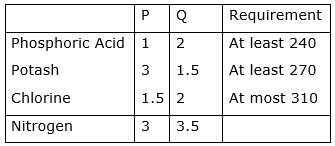


Let the number of bags of P and Q chosen be ‘x’ and ‘y’ units.


Nitrogen from P = 3x


Nitrogen from Q = 3.5y


Nitrogen form the mixture = 3x + 3.5y


Now,


x + 2y ≥ 240


i.e. the minimum requirement of phosphoric acid in the mixture of P and Q is 240 kgs, each of which contains 1kg and 2kgs of phosphoric acid respectively


3x + 1.5y ≥ 270


i.e. the minimum requirement of Potash in the mixture of P and Q is 270 kgs, each of which contains 3kgs and 1.5kgs of Potash respectively.


1.5x + 2y ≤ 310


i.e. the maximum requirement of Chlorine in the mixture of P and Q is 310 kgs, each of which contains 1.5kgs and 2kgs of Chlorine respectively.


Hence, mathematical formulation of the LPP is as follows:


Find ‘x’ and ‘y’ that


Minimises Z = 3x + 3.5y


Subject to the following constraints:


(i) x + 2y ≥ 240


(ii) 3x + 1.5y ≥ 270


(iii) 1.5x + 2y ≤ 310


(iv) x,y ≥0 ( quantity cant be negative)


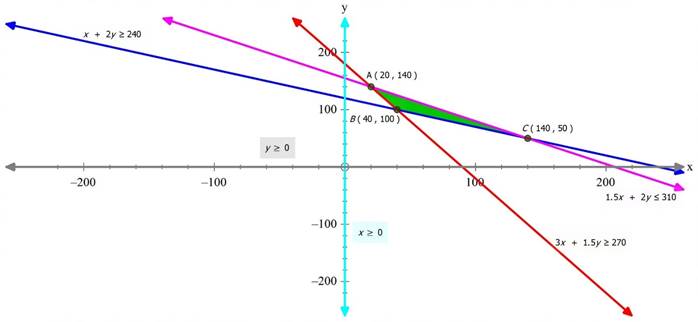
The feasible region is bounded (ABC)


The corner points of the feasible region is as follows:


Z is minimised at B(40,100)


The minimum amount of Nitrogen in the mixture is 470kgs


More from this chapter

All 118 →
13

A farmer mixes two brands P and Q of cattle feed. Brand P, costing ₹ 250 per bag, contains 3 units of nutritional element A, 2.5 units of element B and 2 units of element C. Brand Q costing ₹ 200 per bag contains 1.5 units of nutritional element A, 11.25 units of element B, and 3 units of element C. The minimum requirements of nutrients A, B and C are 18 units, 45 units and 24 units respectively. Determine the number of bags of each brand which should be mixed in order to produce a mixture having a minimum cost per bag? What is the minimum cost of the mixture per bag?

14

A dietician wishes to mix together two kinds of food X and Y in such a way that the mixture contains at least 10 units of vitamin A, 12 units of vitamin B and 8 units of vitamin C. The vitamin contents of one kg food is given below :


One kg of food X costs ₹16 and one kg of food Y costs ₹ 20. Find the least cost of the mixture which will produce the required diet?

1

If a young man drives his scooter at a speed of 25 km/hr, he has to spend Rs2 per km on petrol. If he drives the scooter at a speed of 40 km/hour, it produces air pollution and increases his expenditure on petrol to Rs 5 per km. He has a maximum of Rs100 to spend on petrol and travel a maximum distance in one hour time with less pollution. Express this problem as an LPP and solve it graphically. What value do you find here?

2

A manufacturer has three machines installed in his factory. Machines I and II are capable of being operated for at most 12 hours whereas Machine III must operate at least for 5 hours a day. He produces only two items, each requiring the use of three machines. The number of hours required for producing one unit each of the items on the three machines is given in the following table :


He makes a profit of Rs 6.00 on item A and Rs 4.00 on item B. Assuming that he can sell all that he produces, how many of each item should he produce to maximize his profit? Determine his maximum profit. Formulate this LPP mathematically and then solve it.