
A man owns a field of area 1000 sq.m. He wants to plant fruit trees in it. He has a sum of 1400 to purchase young trees. He has the choice of two type of trees. Type A requires 10 sq.m of ground per tree and costs ₹ 20 per tree and type B requires 20 sq.m of ground per tree and costs ₹ 25 per tree. When fully grown, type A produces an average of 20 kg of fruit which can be sold at a profit of ₹ 2.00 per kg and type B produces an average of 40 kg of fruit which can be sold at a profit of ₹ 1.50 per kg. How many of each type should be planted to achieve maximum profit when the trees are fully grown? What is the maximum profit?
Let the required number of trees of Type A and B be Rs x and Rs y respectively.
Number of trees cannot be negative.
x,y  0.
0.
To plant tree of Type A requires 10 sq. m and Type B requires 20 sq. m of ground per tree. And it is given that a man owns a field of area 1000 sq. m. Therefore,
10x + 20y 1000
1000
x + 2y 100
100
Type A costs Rs 20 per tree and Type B costs Rs 25 per tree. Therefore, x trees of type A and y trees of type B cost Rs 20x and Rs 25y respectively. A man has a sum of Rs 1400 to purchase young trees.
20x + 25y  1400
1400
4x + 5y 280
280
Thus the mathematical formulation of the given LPP is
Max Z = 40x - 20x + 60y - 25y = 20x + 35y
Subject to,
x + 2y 100
100
4x + 5y 280
280
x,y  0
0
Region 4x + 5y 280: line 4x + 5y
 280 meets axes at
  (70,0),
  (0,56) respectively.
The region containing origin represents 4x + 5y 280 as (0,0) satisfies 4x + 5y
 280.
280.
Region x + 2y 100: line x + 2y = 100 meets axes at
  (100,0),
  (0,50) respectively.
Region containing origin represents x + 2y 100 as (0,0) satisfies x + 2y
 100
100
Region x,y  0: it represents the first quadrant.
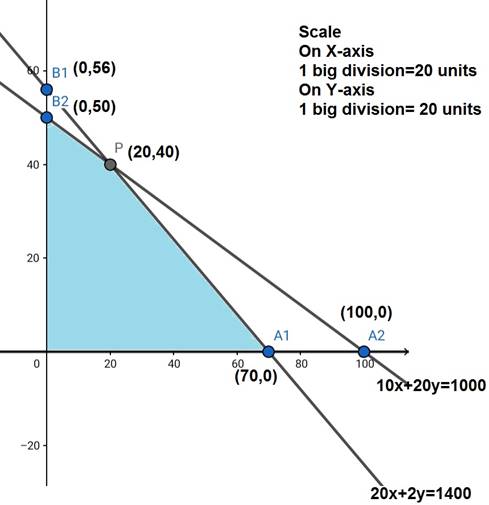
The corner points are  (70,0), P(20,40),
  (0,50)
The values of Z at these corner points are as follows:
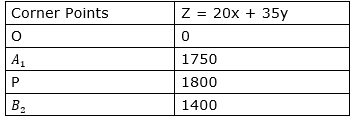
The maximum value of Z is 1800 which is attained at P(20,40).
Thus the maximum profit is Rs 1800 obtained when Rs 20 were involved in Type A and Rs 40 were involved in Type II.
Couldn't generate an explanation.
Generated by AI. May contain inaccuracies — always verify with your textbook.
