
Two tailors, A and B earn ₹ 15 and ₹ 20 per day respectively. A can stitch 6 shirts and 4 pants while B can stitch 10 shirts and 4 pants per day. How many days shall each work if it is desired to produce (at least) 60 shirts and 32 pants at a minimum labour cost?
Let tailor A work for x days and tailor B work for y days.
In one day, A can stitch 6 shirts and 4 pants whereas B can stitch 10 shirts and 4 pants.
Thus in x days, A can stitch 6x shirts and 4x pants whereas in y days B can stitch 10y shirts and 4y pants.
It is given that the minimum requirement of the shirt and pants are respectively 60 and 32.
Thus,
6x + 10y  60
60
4x + 4y  32
32
Further it is given that A and B earn Rs 15 and Rs 20 per day respectively. Thus, A earn Rs 15x and B earns Rs 20y.
Let Z denotes the total cost
Z = 15x + 20y
Days cannot be negative.
x,y  0.
0.
MIN Z = 15x + 20y
Subject to
6x + 10y  60
60
4x + 4y  32
32
x,y  0
0
First we will convert inequations into equations as follows:
6x + 10y = 60, 4x + 4y = 32, x = 0, y = 0
Region represented by 6x + 10y  60
60
The line 6x + 10y = 60 meets the coordinate axes at A(10,0) and B(0,6) respectively. By joining these points we obtain the line 6x + 10y = 60. Clearly (0, 0) satisfies the 6x + 10y  60. So, the region which does not contains the origin represents the solution set of the inequation 6x + 10y
  60
60
Region represented by 4x + 4y  32
32
The line 4x + 4y = 32 meets the coordinate axes at C(8,0) and D(0,8) respectively. By joining these points we obtain the line 4x + 4y = 32. Clearly (0, 0) satisfies the 4x + 4y  32. So, the region which does not contains the origin represents the solution set of the inequation 4x + 4y
  32.
32.
Region represented by x  0, y
0, y  0 :
0 :
Since, every point in the first quadrant satisfies these inequations. So, the first quadrant is the region represented by the inequations x  0 and y
  0.
0.
The feasible region determined by the system of constraints 6x + 10y  60, 4x + 4y
  32
32
x,y  0 are as follows.
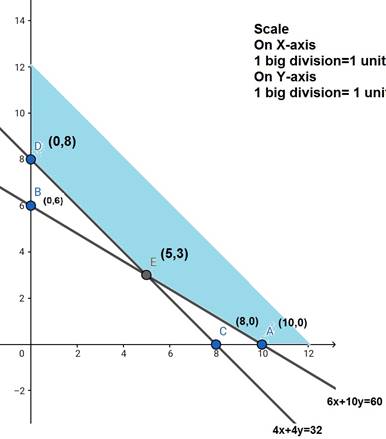
The corner points are D(0,8), E(5,3), A(10,00. The values of Z at these corner points are as follows:
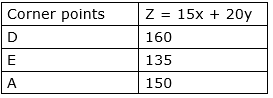
The minimum value of Z is 135 which is attained at E(5,3).
Thus, for minimum labour cost, A should work for 5 days and B should work for 3 days.
Couldn't generate an explanation.
Generated by AI. May contain inaccuracies — always verify with your textbook.
