Q15 of 118 Page 30

A firm has to transport at least 1200 packages daily using large vans which carry 200 packages each and small vans which can take 80 packages each. The cost of engaging each large van is Rs 400 and each small van is Rs 200. Not more than Rs 3000 is to be spent daily on the job and the number of large vans cannot exceed the number of small vans. Formulate this problem as a LPP given that the objective is to minimize cost.

Given information can be tabulated as below:
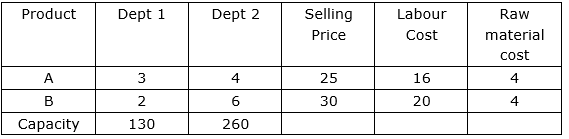


Let the required product of product A and B be x and y units respectively.


Given, labour cost and raw material cost of one unit of product A is Rs 16 and Rs 4, so total cost of product A is Rs 16 + Rs 4 = Rs 20


And given selling price of 1 unit of product A is Rs 25,


So, profit on one unit of product


A = 25 - 20 = Rs 5


Again, given labour cost and raw material cost of one unit of product B is Rs 20 and Rs 4 So, that cost of product B is Rs 20 + Rs 4 = Rs 24


And given selling price of 1 unit of product B is Rs 30


So, profit on one unit of product B = 30 - 24 = Rs 6


Hence, profits on x unit of product A and y units of product B are Rs 5x and Rs 6y respectively.


Let Z be the total profit, so,


Z = 5x + 6y


Given, production of one unit of product A and B need to process for 3 and 4 hours respectively in department 1, so production of x units of product A and y units of product B need to process for 3x and 4y hours respectively in Department 1. But total capacity of Department 1 is 130 hours,


So, 3x + 2y 130 (First constraint)


Given, production of one unit of product. A and B need to process for 4 and 6 hours respectively in department 2, so production of x units of product A and y units of product B need to process for 4x and 6y hours respectively in Department 2 but total capacity of Department 2 is 260 hours


So, 4x + 6y 260 (Second constraint)


Hence, mathematical formulation of LPP is,


Find x and y which


Maximize Z = 5x + 6y


Subject to constraint,


3x + 2y 130,


4x + 6y 260


x, y 0 [Since production cannot be less than zero]


More from this chapter

All 118 →
13

Amit’s mathematics teacher has given him three long lists of problems with the instruction to submit not more than 100 of them (correctly solved) for credit. The problem in the first set are worth 5 points each, those in the second set are worth 4 points each, and those in the third set are worth 6 points each. Amit knows from experience that he requires on the average 3 minutes to solve a 5 point problem, 2 minutes to solve a 4 point problem, and 4 minutes to solve a 6 point problem. Because he has other subjects to worry about, he cannot afford to devote more than hours altogether to his mathematics assignment. Moreover, the first two sets of problems involve numerical calculations and he knows that he cannot stand more than hours work on this type of problem. Under these circumstances, how many problems in each of these categories shall he do in order to get maximum possible credit for his efforts? Formulate this as a LPP.

14

A farmer has a 100 - acre farm. He can sell the tomatoes, lettuce, or radishes he can raise. The price he can obtain is Rs 1 per kilogram for tomatoes, Rs 0.75 a head for lettuce and Rs 2 per kilogram for radishes. The average yield per acre is 2000 kgs for radishes, 3000 heads of lettuce and 1000 kilograms of radishes. Fertilizer is available at Rs 0.50 per kg and the amount required per acre is 100 kgs each for tomatoes and lettuce and 50 kilograms for radishes. Labour required for sowing, cultivating and harvesting per acre is 5 man - days for tomatoes and radishes and 6 man – days for lettuce. A total of 400 man - days of labour are available at ₹ 20 per man - day. Formulate this problem as a LPP to maximize the farmer’s total profit.

16

A firm manufactures two products, each of which must be processed through two departments, 1 and 2. The hourly requirements per unit for each product in each department, the weekly capacities in each department, selling price per unit, labour cost per unit, and raw material cost per unit are summarized as follows :


The problem is to determine the number of units to produce each product so as to maximize total contribution to profit. Formulate this as a LPP.

1

Solve each of the following linear programming problems by graphical method.

Maximize Z = 5x + 3y


Subject to :


3x + 5y ≤ 15


5x + 2y ≤ 10


x, y ≥ 0