
A dietician has to develop a special diet using two foods P and Q. Each packet (containing 30 g) of food P contains 12 units of calcium, 4 units of iron, 6 units of cholesterol and 6 units of vitamin A. Each packet of the same quantity of food Q contains 3 units of calcium, 20 units of iron, 4 units of cholesterol and 3 units of vitamin A. The diet requires at least 240 units of calcium, at least 460 units of iron and at most 300 units of cholesterol. How many packets of each food should be used to minimize the amount of vitamin A in the diet? What is the minimum amount of vitamin A?
The above information can be expressed with the help of the following table
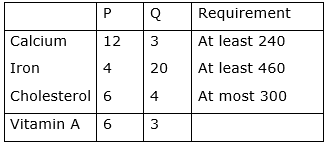
Let the number of packets bought, of P and Q, be ‘x’ and ‘y’
Vitamin A from P = 6x
Vitamin A from Q = 3y
Vitamin A in the diet = 6x + 3y
Now,
⟹ 12x + 3y ≥ 240
i.e. the minimum requirement of Calcium in the diet, form both the foods combined, is 240units, each of which has 12units and 3units of calcium respectively.
⟹ 4x + 20y ≥ 460
i.e. the minimum requirement of Iron from P and Q combined is 460 units, each of which has 4units and 20units of iron respectively.
⟹ 6x + 4y ≤ 300
i.e. the maximum requirement of Cholesterol from P and Q combined is 300 units, each of which contains 6units and 4units of cholesterol respectively.
Hence, the mathematical formulation of the LPP is as follows:
Find ‘x’ and ‘y’ that:
Minimises Z = 6x + 3y
Subject to the following constraints:
(i) 12x + 3y ≥ 240
i.e. 4x + y ≥ 80
(ii) 4x + 20y ≥ 460
i.e. x + 5y ≥ 115
(iii) 6x + 4y ≤ 300
i.e. 3x + 2y ≤ 150
(iv) x,y ≥0 (∵ quantity cant be negative)
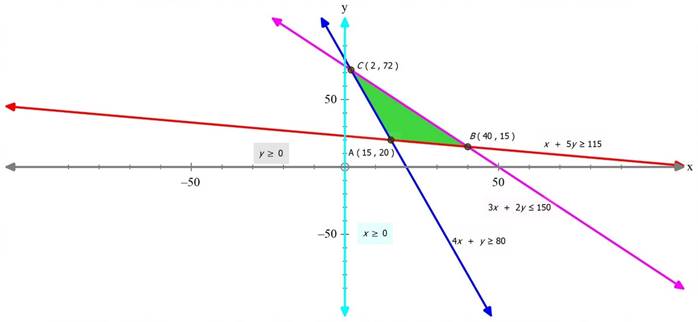
The feasible region is bounded (ABC)
The corner points of the feasible region are as follows:
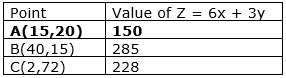
Z is minimised at A(15,20) i.e. 15 packets of P and 20 packets of Q should be used to minimise the amount of vitamin A.
The minimum amount of vitamin A is 150 units.
Couldn't generate an explanation.
Generated by AI. May contain inaccuracies — always verify with your textbook.
