Q15 of 118 Page 31

A publisher sells a hard cover edition of a text book for ₹ 72.00 and a paperback edition of the same ext for ₹ 40.00. Costs to the publisher are ₹ 56.00 and ₹ 28.00 per book respectively in addition to weekly costs of ₹ 9600.00. Both types require 5 minutes of printing time, although hardcover requires 10 minutes binding time and the paperback requires only 2 minutes. Both the printing and binding operations have 4,800 minutes available each week. How many of each

type of book should be produced in order to maximize profit?

Let the sale of hand cover edition be ‘h’ and that of paperback editions be ‘t’.


SP of a hard cover edition of the textbook = Rs 72


SP of a paperback edition of the textbook = Rs 40


Cost to the publisher for hard cover edition = Rs 56


Cost to the publisher for a paperback edition = Rs 28


Weekly cost to the publisher = Rs 9600


Profit to be maximized, Z = (72 - 56)h + (40 - 28)t – 9600


Z = 16h + 12t - 9600


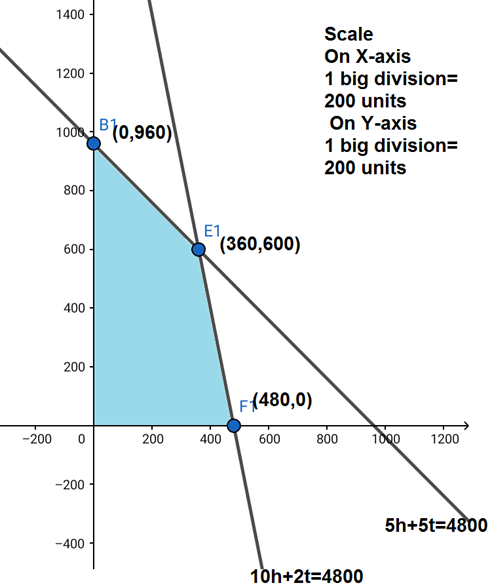
5(h + t) 4800


10h + 2t 4800.


15.png


The corner Points are O(0,0), (0,960), (360,600) and (480,00).


The values of Z at these corner points are as follows:
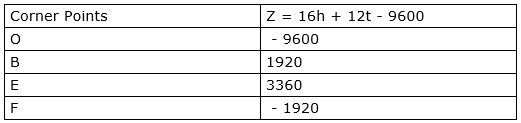


The maximum value of Z is 3360 which is attained at (360,600).


The maximum profit is 3360 which is obtained by selling 360 copies of hardcover edition and 600 copies paperback edition.


More from this chapter

All 118 →
13

A firm manufacturing two type of electric items, A and B, can make a profit of 20 per unit of A and ₹ 30 per unit of B. Each unit of A requires 3 motors and 4 transformers and each unit of B requires 2 motors and 4 transformers. The total supply of these per month is restricted to 210 motors and 300 transformers. Type B is an export model requiring a voltage stabilizer which has a supply restricted to 65 units per month. Formulate the linear programming problem for maximum profit and solve it graphically.

14

A factory uses three different resources for the manufacture of two different products,20 units of the resources a, 12 units of B and 16 units of C being available 1 unit of the first product requires 2,2 and 4 units of the respective resources and 1 unit of the second product requires 4,2 and 0 units of respective resources. It is known that the first product gives a profit of 2 monetary units per unit and the second 3. Formulate the linear programming problem. How many units of each product should be manufactured for maximizing the profit? Solve it graphically.

16

A firm manufactures headache pills in two sizes A and b. Size A contains 2 grains of aspirin, 5 grains of bicarbonate and 1 grain of codeine ; size B contains 1 grain of aspirin, 8 grains of bicarbonate and 66 grains of codeine. It has been found by users that it requires at least 12 grains of aspirin, 7.4 grains of bicarbonate and 24 grains of codeine for providing immediate effects. Determine graphically the least number of pills a patient should have to get immediate relief. Determine also the quantity of codeine consumed by patient.

17

A chemical company produces two compounds, A and B. The following table gives the units of ingredients, C and D per kg of compounds A and B as well as minimum requirements of C and D and costs per kg of A and B. Find the quantities of A and B which would give a supply of C and D at a minimum cost.