Q6 of 118 Page 30

A diet is to contain at least 80 units of vitamin A and 100 units of minerals. Two foods F1 and F2 are available. Food F2 costs ₹ 4 per unit F2 costs ₹ 6 per unit one unit of food F1 contains 3 units of vitamin A and 4 units of minerals. One unit of food F2 contains 6 units of vitamin A and 3 units of minerals. Formulate this as a linear programming problem and find graphically the minimum cost for diet that consists of mixture of these foods and also meets the mineral nutritional requirements.

The above information can be expressed in the following table:
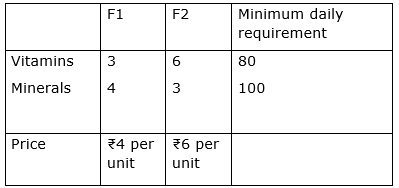


Let the quantity of the foods F1 and F2 be ‘x’ and ‘y’ respectively.


Cost of food F1 = 4x


Cost of food F2 = 6y


Cost of Diet = 4x + 6y


Now,


3x + 6y ≥ 80


i.e. the minimum requirement of Vitamins from the two foods is 80units, each of which contains 3units and 6units of Vitamins.


4x + 3y ≥ 100


i.e. the minimum requirement of minerals firm the two foods is 100units, each of which contains 4unit and 3 units of vitamins.


Hence, mathematical formulation of the LPP is as follows:


Find ‘x’ and ‘y’ that:


Minimise Z = 4x + 6y


Subject to the following constraints:


(i) 3x + 6y ≥ 80


(ii) 4x + 3y ≥ 100


(iii) x,y ≥ 0 ( quantity cant be negative)


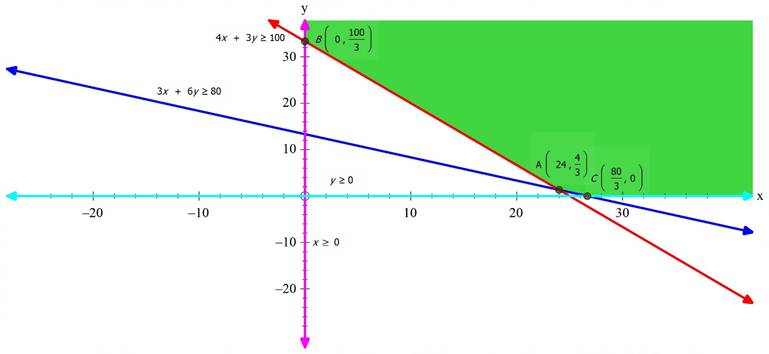
The feasible region is unbounded.


The corner points of the feasible region is as follows:
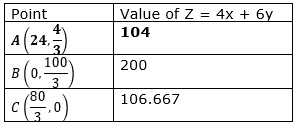


Z is smallest at


Let us consider 4x + 6y ≤ 104


As it has no intersection with the feasible region, the smallest value is the minimum value.


The minimum cost of diet is ₹104.


More from this chapter

All 118 →
4

A hospital dietician wishes to find the cheapest combination of two foods, A and B, that contains at least 0.5 milligram of thiamine and at least 600 calories. Each unit of A contains 0.12 milligram of thiamine and 100 calories, while each unit of B contains 0.10 milligram of thiamine and 150 calories. If each food costs 10 paise per unit, how many units of each should be combined at a minimum cost?

5

A dietician mixes together two kinds of food in such a way that the mixture contains at least 6 units of vitamin A, 7 units of vitamin B, 11 units of vitamin C and 9 units of vitamin D. The vitamin contents of 1 kg of food X and 1 kg of food Y are given below :


One kg of food X costs ₹ 5, whereas one kg of food Y costs ₹ 8. Find the least cost of the mixture which will produce the desired diet.

7

Kellogg is a new cereal formed of a mixture of bran and rice that contains at least 88 grams of protein and at least 36 milligrams of iron. Knowing that bran contains 80 grams of protein and 40 milligrams of iron per kilogram, and that rice contains 100 grams of protein and 30 milligrams of iron per kilogram, find the minimum cost of producing this new cereal if bran costs ₹ 5 per kg and rice costs ₹ 4 per kg.

8

A wholesale dealer deals in two kinds, A and B (say) of mixture of nuts. Each kg of mixture A contains 60 grams of almonds, 30 grams of cashew nuts and 30 grams of hazel nuts. Each kg of mixture B contains 30 grams of almonds, 60 grams of cashew nuts and 180 grams of hazel nuts. The remainder of both mixtures is per nuts. The dealer is contemplating to use of cashew nuts and 540 grams of hazel nuts. Mixture A costs ₹ 8 per kg. and mixture B costs ₹ 12 per kg. Assuming that mixtures A and B are uniform, use graphical method to determine the number of kg. of each mixture he should use to minimize the cost of the bag.