Q11 of 118 Page 31

One kind of cake requires 200 g of flour and 25 g of fat, and another kind of cake requires 100 g of flour and 50 g of fat. Find the maximum number of cakes which can be made from 5 kg of flour and 1 kg of fat assuming that there is no shortage of the other ingredients used in making the cakes.

The above information can be expressed in the form of the following table:
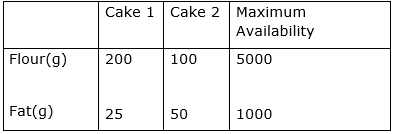


Let the number of Cake 1 and Cake 2 be made be ‘x’ and ‘y’


Number of cakes made = x + y


Now,


200x + 100y ≤ 5000


i.e. the maximum flour available for both the cakes combined is 5000g, each of which requires 200g and 100g of flour respectively.


25x + 50y ≤ 1000


i.e. the maximum fat available for the two cakes combined is 1000g, each of which requires 25g and 50g of fat respectively.


Hence, the mathematical formulation of the LPP is as follows:


Find ‘x’ and ‘y’ that:


Maximises Z = x + y


Subject to the following constraints:


(i) 200x + 100y ≤ 5000


i.e. 2x + y ≤ 50


(ii) 25x + 50y ≤ 1000


i.e. x + 2y ≤ 40


(iii) x,y ≥ 0 ( quantity cant be negative)


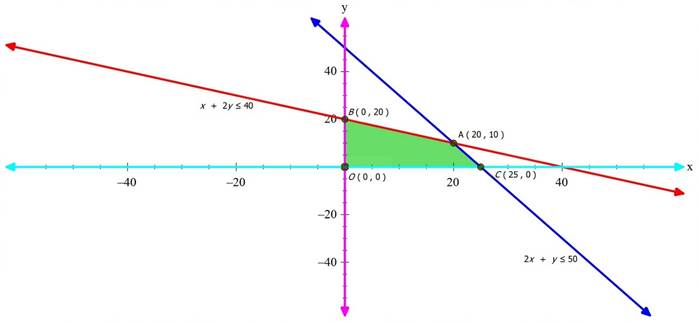
The feasible region is bounded (OBAC)


The corner points of the feasible region is as follows:
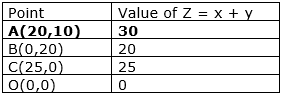


Z is maximised at A(20,10)


The maximum number of cakes that can be made are 30.


More from this chapter

All 118 →
9

One kind of cake requires 300 gm of flour and 15 gm of fat, another kind of cake requires 150 gm of flour and 30 gm of fat. Find the maximum number of cakes which can be made from 7.5 kg of flour and 600 gm of fat, assuming that there is no shortage of the other ingredients used in making the cakes. Make it as an LPP and solve it graphically.

10

Reshma wishes to mix two types of food P and Q in such a way that the vitamin contents of the mixture contain at least 8 units of vitamin A and 11 units of vitamin B. Food P costs ₹ 60 kg and Food Q costs ₹ 80 kg. Food P contains 3 units / kg of Vitamin A and 5 units / kg of Vitamin B while food Q contains 4 units / kg of Vitamin A and 2 units / kg of vitamin B. Determine the minimum cost of the mixture.

12

A dietician has to develop a special diet using two foods P and Q. Each packet (containing 30 g) of food P contains 12 units of calcium, 4 units of iron, 6 units of cholesterol and 6 units of vitamin A. Each packet of the same quantity of food Q contains 3 units of calcium, 20 units of iron, 4 units of cholesterol and 3 units of vitamin A. The diet requires at least 240 units of calcium, at least 460 units of iron and at most 300 units of cholesterol. How many packets of each food should be used to minimize the amount of vitamin A in the diet? What is the minimum amount of vitamin A?

13

A farmer mixes two brands P and Q of cattle feed. Brand P, costing ₹ 250 per bag, contains 3 units of nutritional element A, 2.5 units of element B and 2 units of element C. Brand Q costing ₹ 200 per bag contains 1.5 units of nutritional element A, 11.25 units of element B, and 3 units of element C. The minimum requirements of nutrients A, B and C are 18 units, 45 units and 24 units respectively. Determine the number of bags of each brand which should be mixed in order to produce a mixture having a minimum cost per bag? What is the minimum cost of the mixture per bag?