Q12 of 118 Page 30

An airline agrees to charter planes for a group. The group needs at least 160 first class seats and at least 300 tourist class seats. The airlines must use at least two of its model 314 planes which have 20 first class and 30 tourist class seats. The airline will also use some of its model 535 planes which have 20 first class seats and 60 tourist class seats. Each flight of a model 314 plane costs the company Rs 100, 000 and each flight of a model 535 plane costs Rs 150, 000. How many of each type of plane should be used to minimize the flight cost? Formulate this as a LPP.
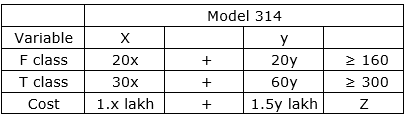

The above LPP can be presented in a table above.


The flight cost is to be minimized i.e; Min Z = x + 1.5y


the constraints


x 2 at least 2 planes of model 314 must be used


y ≥ 0 at least 1 plane of model .53.5 must be used


20x + 20y 160 require at least 160 F class seats


30x + 60y 300 require at least 300 T class seats


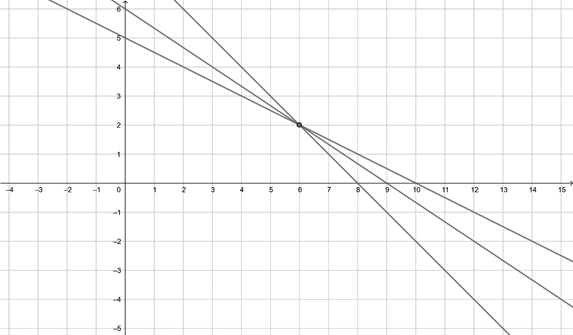
Solving the above inequalities as equations we get,


When x = 0, y = 8 and when y = 0, x = 8


When x = 0, y = 5 and when y = 0, x = 10


We get an unbounded region 8 - E - 10 as a feasible solution. Plotting the corner points and evaluating we have,
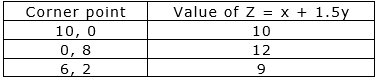


Since we obtained an unbounded region as the feasible solution a plot of Z (x + 1.5y< 9) is plotted.


Since there are no common points point E is the point that gives a minimum value.


Using 6 planes of model 314 & 2 of model 535 gives minimum cost of 9 lakh rupees.


More from this chapter

All 118 →
10

An automobile manufacturer makes automobiles and trucks in a factory that is divided into two shops. Shop A, which performs the basic assembly operation, must work 5 man - days on each truck but only 2 man - days on each automobile. Shop B which performs finishing operations, must work 3 man - days for each automobile or truck that it produces. Because of men and machine limitations, shop A has 180 man - days per week available while shop B has 135 man - days per week. If the manufacturer makes a profit of Rs 30000 on each truck and Rs 2000 on each automobile, how many of each should he produce to maximize his profit? Formulate this as a LPP.

11

Two tailors A and B earn Rs 150 and Rs 200 per day respectively. A can stitch 6 shirts and 4 pants per day while B can stitch 10 shirts and 4 pants per day. Form a linear programming problem to minimize the labour cost to produce at least 60 shirts and 32 pants.

13

Amit’s mathematics teacher has given him three long lists of problems with the instruction to submit not more than 100 of them (correctly solved) for credit. The problem in the first set are worth 5 points each, those in the second set are worth 4 points each, and those in the third set are worth 6 points each. Amit knows from experience that he requires on the average 3 minutes to solve a 5 point problem, 2 minutes to solve a 4 point problem, and 4 minutes to solve a 6 point problem. Because he has other subjects to worry about, he cannot afford to devote more than hours altogether to his mathematics assignment. Moreover, the first two sets of problems involve numerical calculations and he knows that he cannot stand more than hours work on this type of problem. Under these circumstances, how many problems in each of these categories shall he do in order to get maximum possible credit for his efforts? Formulate this as a LPP.

14

A farmer has a 100 - acre farm. He can sell the tomatoes, lettuce, or radishes he can raise. The price he can obtain is Rs 1 per kilogram for tomatoes, Rs 0.75 a head for lettuce and Rs 2 per kilogram for radishes. The average yield per acre is 2000 kgs for radishes, 3000 heads of lettuce and 1000 kilograms of radishes. Fertilizer is available at Rs 0.50 per kg and the amount required per acre is 100 kgs each for tomatoes and lettuce and 50 kilograms for radishes. Labour required for sowing, cultivating and harvesting per acre is 5 man - days for tomatoes and radishes and 6 man – days for lettuce. A total of 400 man - days of labour are available at ₹ 20 per man - day. Formulate this problem as a LPP to maximize the farmer’s total profit.