Skip to content
Philoid
Browse Saved
Back to chapter
Mathematics
14. Quadrilaterals
Home · Class 9 · Mathematics · Ref. Book · 14. Quadrilaterals
Prev
Next
Q6 of 95 Page 14

P and Q are the points of trisection of the diagonal BD of a parallelogram ABCD. Prove that CQ is parallel to AP. Proves also that AC bisects PQ.

Given,


In a parallelogram ABCD


Since diagonal of parallelogram bisects each other


OA = OC and OB = OD


Since P&Q are the point of trisection of BD


BP = PQ = QD
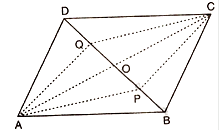


Now, OB = OD and BP = QD


OB-BP = OD-QD


OP = OQ


Diagonals of quadrilateral bisect each other


Hence, APCQ is a parallelogram.


More from this chapter

All 95 →
4

ABCD is a rectangle with ∠ABD=40°. Determine ∠DBC.

5

The sides AB and CD of a parallelogram ABCD are bisected at E and F. Prove that EBFD is a parallelogram.

7

ABCD is a square E, F, G and H are points on AB, BC, CD and DA respectively, such that AE=BF=CG=DH. Prove that EFGH is a square.

8

ABCD is a rhombus, EABF is a straight line such that EA=AB=BF. Prove that ED and FC when produced meet at right angles.

Questions · 95
14. Quadrilaterals
1 2 3 4 1 2 3 4 5 6 7 8 9 10 1 2 3 4 5 6 7 8 9 1 2 3 4 5 6 7 8 9 10 11 12 13 14 15 16 17 18 19 20 1 2 3 4 5 6 7 8 9 10 11 12 13 14 15 16 17 18 19 20 1 2 3 4 5 6 7 8 9 10 11 12 13 14 15 16 17 18 19 20 21 22 23 24 25 26 27 28 29 30 31 32
Back to chapter
ADVERTISEMENT
About Contact Privacy Terms
Philoid · 2026
  • Home
  • Search
  • Browse
  • Quiz
  • Saved