Skip to content
Philoid
Browse Saved
Back to chapter
Mathematics
14. Quadrilaterals
Home · Class 9 · Mathematics · Ref. Book · 14. Quadrilaterals
Prev
Next
Q14 of 95 Page 15

ABC is a triangle. D is a point on AB such that AD=AB and E is a point on AC such that AE= AC. Prove that DE=BC.

Given,


Let P and Q be the mid points of AB and AC respectively
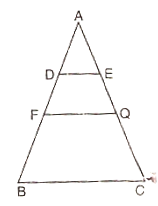


Then, PQ ││BC and PQ=…………….(i)


In ∆APQ, D and E are mid points of AP and AQ resp.


∴DE││PQ , DE= ………….(ii)


From (i) and(ii)


=DE=


= DE =


More from this chapter

All 95 →
12

ABCD is a kite having AB=AD and BC=CD. Prove that the figure formed by joining the mid-points of the sides, in order, is a rectangle.

13

Let ABC be an isosceles triangle in which AB=AC. If D, E, F be the mid-points of the sides BC, CA and AB respectively, show that the segment AD and EF bisect each other at right angles.

15

In Fig. 14.99, ABCD is a parallelogram in which P is the mid-point of DC and Q is a point on AC such that CQ= AC. If PQ produced meets BC at R, Prove that R is a mid-point of BC.

16

In Fig. 14.100, ABCD and PQRC are rectangles and Q is the mid-point of AC. Prove that


(i) DP = PC (ii) PR = AC.

Questions · 95
14. Quadrilaterals
1 2 3 4 1 2 3 4 5 6 7 8 9 10 1 2 3 4 5 6 7 8 9 1 2 3 4 5 6 7 8 9 10 11 12 13 14 15 16 17 18 19 20 1 2 3 4 5 6 7 8 9 10 11 12 13 14 15 16 17 18 19 20 1 2 3 4 5 6 7 8 9 10 11 12 13 14 15 16 17 18 19 20 21 22 23 24 25 26 27 28 29 30 31 32
Back to chapter
ADVERTISEMENT
About Contact Privacy Terms
Philoid · 2026
  • Home
  • Search
  • Browse
  • Quiz
  • Saved