Skip to content
Philoid
Browse Saved
Back to chapter
Mathematics
14. Quadrilaterals
Home · Class 9 · Mathematics · Ref. Book · 14. Quadrilaterals
Prev
Next
Q19 of 95 Page 15

ABCD is a parallelogram and E is the mid point of BC.DE and AB when produced meet at F. Then, AF=

Given,


ABCD is a parallelogram
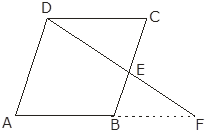


E is mid point of BC


DE & AB after producing meet at F


In ∆ECD & ∆BEF ,


∠BEF = ∠CED [vertically opposite angles]


BE = EC


∠EDC = ∠EFB [ alternate angles]


∴ ∆ECD ≅ ∆BEF


So, CD= BF


∵ AB=CD


Thus, AF= AB+ BF


= AF = AB + CD


= AF = AB+AB


= AF = 2AB

More from this chapter

All 95 →
17

ABCD is a parallelogram and E and F are the centroids of triangles ABD and BCD respectively, then EF=

18

ABCD is a parallelogram M is the mid-point of BD and BM bisects ∠B. Then, ∠AMB=

20

If an angle of a parallelogram is two-third of its adjacent angle, the smallest angle of the parallelogram is

21

If the degree measures of the angles of quadrilateral are 4x, 7x, 9x and 10x, what is the sum of the measures of the smallest angle and largest angle?

Questions · 95
14. Quadrilaterals
1 2 3 4 1 2 3 4 5 6 7 8 9 10 1 2 3 4 5 6 7 8 9 1 2 3 4 5 6 7 8 9 10 11 12 13 14 15 16 17 18 19 20 1 2 3 4 5 6 7 8 9 10 11 12 13 14 15 16 17 18 19 20 1 2 3 4 5 6 7 8 9 10 11 12 13 14 15 16 17 18 19 20 21 22 23 24 25 26 27 28 29 30 31 32
Back to chapter
ADVERTISEMENT
About Contact Privacy Terms
Philoid · 2026
  • Home
  • Search
  • Browse
  • Quiz
  • Saved