Q8 of 95 Page 94

Given below is a diagrammatic representation of certain types of blood vessels in human body.


(a) Identify the types of blood vessels numbered 1 to 5.


(b) Where can such an arrangement be found as an example -in lungs or in heart walls?

(a) In the given figure, the following parts as labelled as:
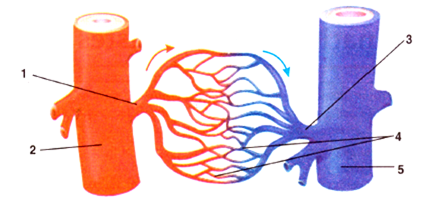


1 : Arterioles (smallest & final branch of artery)


2 : Artery (often shown as red coloured vessel indicating it carries oxygenated blood)


3 : Venules (smallest but united branch of blood vessel)


4 : Capillaries (arterioles & Venules break further & form capillaries)


5 : Veins (blood vessel shown as blue colored vessel indicating it carries de oxygenated blood)


(b) Such an arrangement can be found in the heart walls. (such a complex arrangement of vessels can be found in heart as it is the blood pumping organ . All the blood vessels finally meet & unite in the heart )


More from this chapter

All 95 →
5

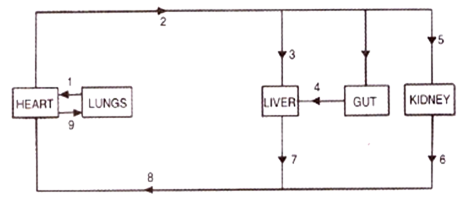
The following simplified diagram refers to the outline plan of the circulation of blood in a mammal. Study the diagram and write the number and the name of the blood vessel in each case as mentioned ahead.


(a) Several hours after a meal containing a lot of protein, which vessel will contain the highest concentration of urea?


(b) Which vessel would contain the highest concentration of amino acids and glucose soon after a meal?,

6

The figures given below show diagrammatic cross sections of three kinds of blood vessels.


(a) Identify the blood vessels A, B and C.


(b) Name the parts labelled 1-4.


(c) Mention two structural differences between A and B.


(d) Name the kinds of blood that flow through A and through B respectively


(e) In which one of the above vessels referred to in (a) above does the exchange of gases actually take place?

7

The diagram given alongside represents the human heart in one phase of its activity. Study the same and then answer the questions that follow:


(a) Name the phase.


(b) Which part of the heart is contracting in this phase? Give a reason to support your answer.


(c) Name the parts numbered 1 to 6.


(d) What type of blood flows through the parts marked ‘1’ and ‘2’ respectively?


(e) How many valves are closed in this phase?

9

Study the following diagram carefully and then answer the questions that follow:

(a) Name the cell labelled 1.


(b) Identify the phenomenon occurring in A.


(c) Mention two structural differences between 1 and 2.


(d) Name the process occurring in B and C and state the importance of this process in the human body.