
Evaluate the following integral:

Denominator is factorized, so let separate the fraction through partial fraction, hence let





By equating similar terms, we get
A + C = 0 ⇒ A = – C ………..(iii)
B + D = 0 ⇒ B = – D …………(iv)
3A + C = 2
⇒ 3( – C) + C = 2 (from equation(iii))
⇒ C = – 1
So equation(iii) becomes A = 1
And also 3B + D = 0 (from equation (ii))
⇒ 3( – D) + D = 0 (from equation (iv))
⇒ D = 0
So equation (iv) becomes, B = 0
We put the values of A, B, C and D values back into our partial fractions in equation (i) and replace this as the integrand. We get
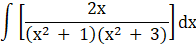


Split up the integral,

Let substitute


so the above equation becomes,
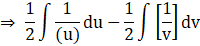
On integrating we get
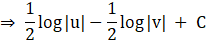
Substituting back, we get


Applying the logarithm rule we get
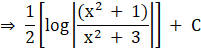
Note: the absolute value signs account for the domain of the natural log function (x>0).
Hence,

Couldn't generate an explanation.
Generated by AI. May contain inaccuracies — always verify with your textbook.


